HSE - Tempesta
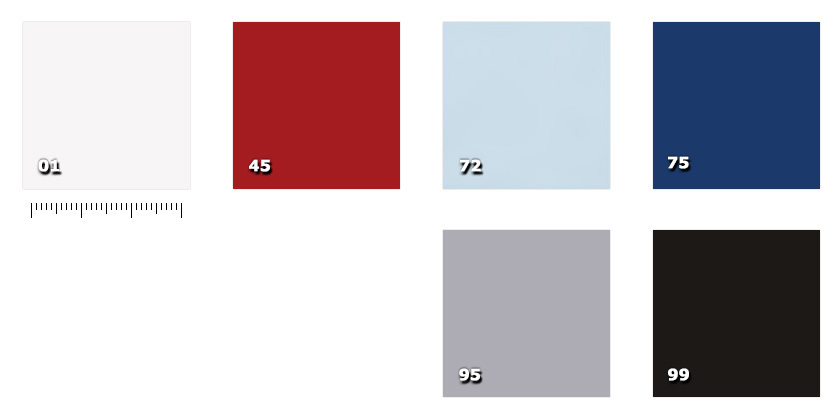
Photo © Peroni
HSE140S - Tempesta - Flameproof
01 white
45. red
72. light blue
75. bleu
95. grey
99. black
01 white
45. red
72. light blue
75. bleu
95. grey
99. black

Photo © Peroni
HSE140S - Tempesta - Flameproof
Special colours available at this time
23. yellow * (153 m)
63. green chroma key * (5,5 m)
* availability limited to the indicated quantity
Special colours available at this time
23. yellow * (153 m)
63. green chroma key * (5,5 m)
* availability limited to the indicated quantity

Photo © Peroni
HSE140N - Tempesta - Not flameproof
01 white
01 white
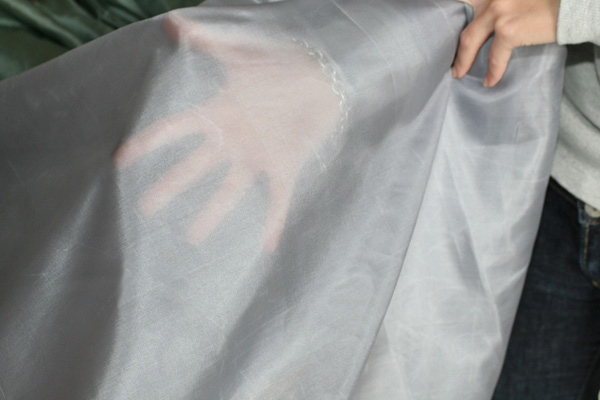
Photo © Peroni
HSE - Tempesta silk
95. grey in half-transparency.
95. grey in half-transparency.

Photo © Teatro de la Maestranza de Sevilla
Teatro de la Maestranza, ''Tannhäuser''
Big sails made of HSE - Tempesta silk 45. red that underlines the extreme lightness and sensibility to the wind of this fabric.

Photo © Visualart-Parenzan / Teatro G. Verdi di Trieste
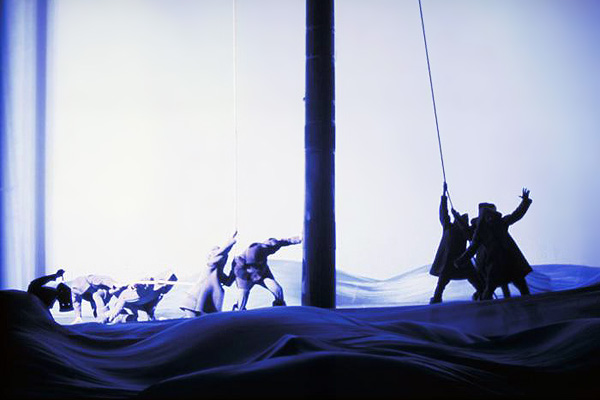
Photo © Luigi Ciminaghi / Piccolo Teatro di Milano
Piccolo Teatro, ''The Tempest''
A preparation that belongs to the history of the modern scenography: Luciano Damiani experimented in a revolutionary and definitive way the use of the silk for scenography, that since then on, in Italy - and in many other countries - it was called ...

Photo © Luigi Ciminaghi / Piccolo Teatro di Milano
... HSE - Tempesta silk.
Damiani used the lightness of the HSE - Tempesta silk to create a shaken and fluctuating surface that simulated the stormy sea, having under the backdrop made of silk numerous actors that shook upward their arms.
Damiani used the lightness of the HSE - Tempesta silk to create a shaken and fluctuating surface that simulated the stormy sea, having under the backdrop made of silk numerous actors that shook upward their arms.

Photo © from I segreti dello spazio teatrale, courtesy of Ubulibri
Piccolo Teatro, ''Faust, fragments''
Projections on a big spiral backdrop made of white HSE - Tempesta silk realized for a famous preparation by Josef Svoboda.
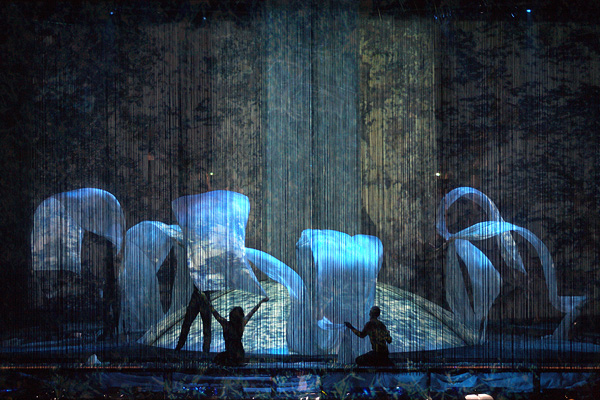
Photo © Alfio Morelli
Ravenna Festival, ''Pietra di diaspro''
Small vaulting backdrops made of white HSE - Tempesta silk in a scene that also uses a backdrop made of threads NTR - Tripolina.
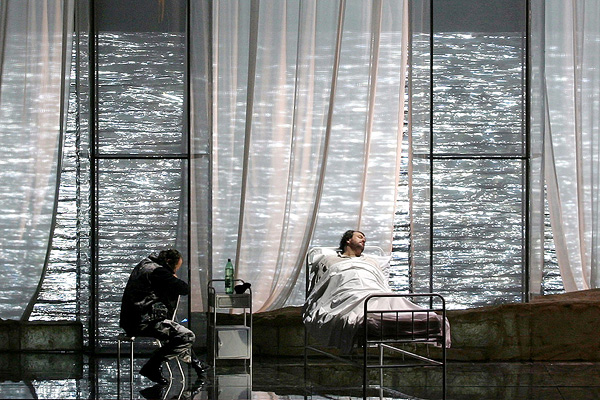
Photo © Luciano Romano / Teatro San Carlo di Napoli
Teatro San Carlo, ''Tristan und Isolde''
The transparency of the white draperies made of HSE - Tempesta silk, placed side by side to the black ones made of EVT - Light Sceno Poly that have been stretched on the frames.
The sea is a realization performed with QSK - Retrafilm.

Photo © Ramella & Giannese / Teatro Regio di Torino
Teatro Regio di Torino, ''The Maid of Orleans''
The semi-transparent flag is made of HSE - Tempesta silk with the colours 01. white, 45. red and 72. light blue.
The mantles of the choir and of Mirella Freni are made of white HSE - Tempesta.
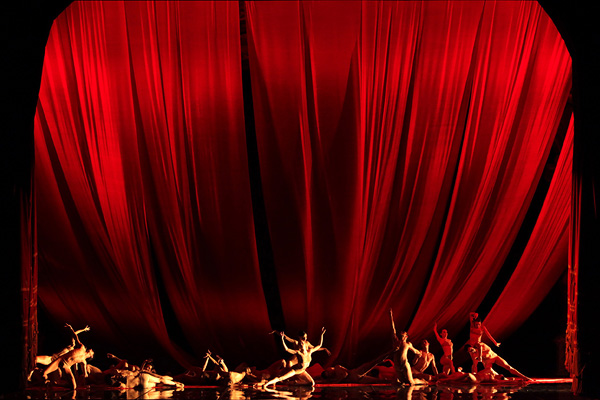
Photo © Marco Brescia & Rudy Amisano
Teatro alla Scala, ''L'altro Casanova''
A big draped backdrop manufactured by the workshop of the Teatro alla Scala with around 450 m² of HSE - Tempesta silk 45. red.

Photo © Teatro della Pergola
Teatro della Pergola, ''Memoirs of Hadrian''
Closed set with a trapezoidal plan made with two layers of soft materials.
The front face is a flat making backdrop made of white HSE - Tempesta silk, here frontally illuminated with blue light ...

Photo © Teatro della Pergola
... and here with yellow light in the center.
The colonnade of the previous photo, and the Pompeian frescoes in this one, are instead rear-projected on a RCO - Colorado backdrop and they can be seen in semi-transparency through the silk.
The colonnade of the previous photo, and the Pompeian frescoes in this one, are instead rear-projected on a RCO - Colorado backdrop and they can be seen in semi-transparency through the silk.
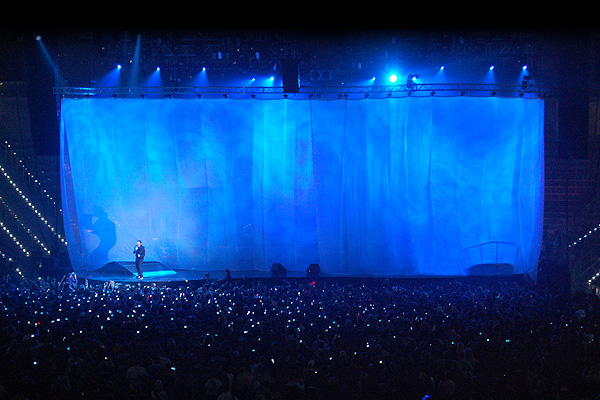
Photo © Lemonandpepper
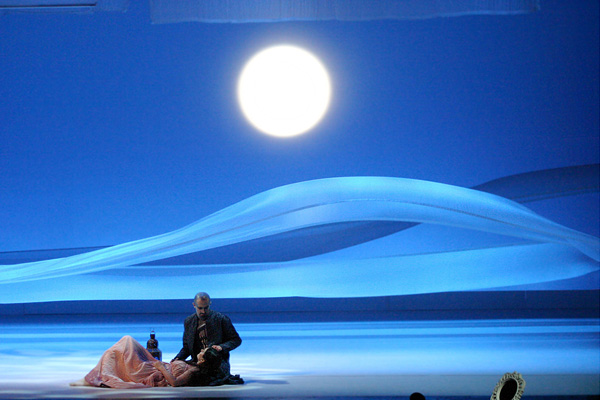
Photo © Zovadelli
Teatro Amilcare Ponchielli, ''Andromeda liberata''
The aerial lightness of three fluctuating backdrops made of white HSE - Tempesta silk, here illuminated with blue light.
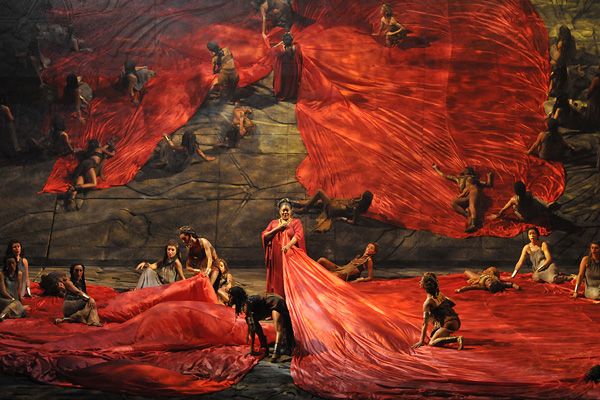
Photo © Michele Crosera
Teatro Verdi of Padua, ''Aida''
Two backdrops made of HSE - Tempesta silk 45. red are reflected in a ZSM - Magic Mirror backdrop 11 m high and 14 m wide.
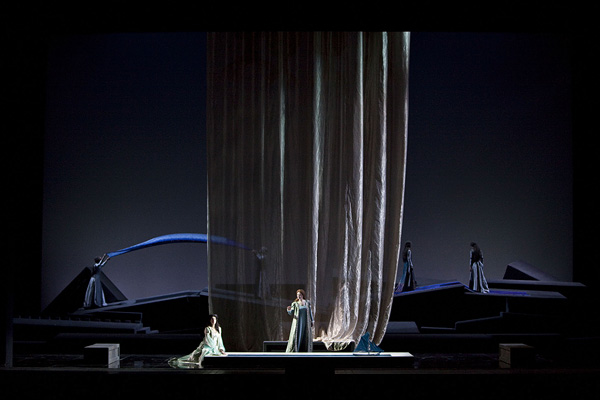
Photo © Marco Brescia / Teatro alla Scala
Teatro alla Scala, ''Simon Boccanegra''
A transparent drapery made of white HSE - Tempesta silk creates a bond among the symbol of an impossible terrestrial purity - the source in the center of the stage - and the celestial transcendence.
The cobalt blue cloth ...
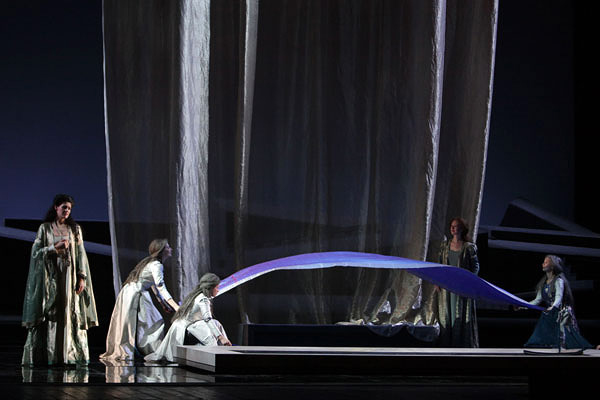
Photo © Marco Brescia / Teatro alla Scala
... here in the foreground, whose color and whose undulations are a symbol of the sea, is realized with a cut of HSE - Tempesta silk dyed on demand.
On the background a Rear-illuminated backdrop made of RNO - Notturno film.
On the background a Rear-illuminated backdrop made of RNO - Notturno film.
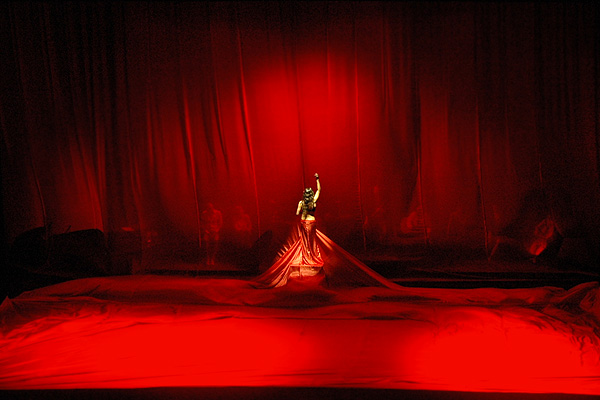
Photo © Moisés Robles
Teatros del Canal, ''Adalí''
A backdrop made of red HSE - Tempesta with flat making, 14 x h 9 m, is tied up to the waist of Aída Gómez as if it were a big skirt.
On the background there is another backdrop, through which the orchestra that accompanies the dance can be seen in semi-transparence ...
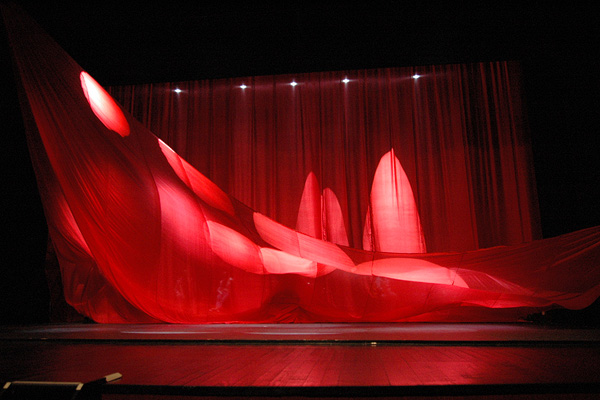
Photo © Moisés Robles
... and it was made up of red HSE - Tempesta silk with vertical fullness 20%.
In the foreground, the skirt made of red HSE - Tempesta of Aída Gómez is grabbed to the corners and lifted ...
In the foreground, the skirt made of red HSE - Tempesta of Aída Gómez is grabbed to the corners and lifted ...
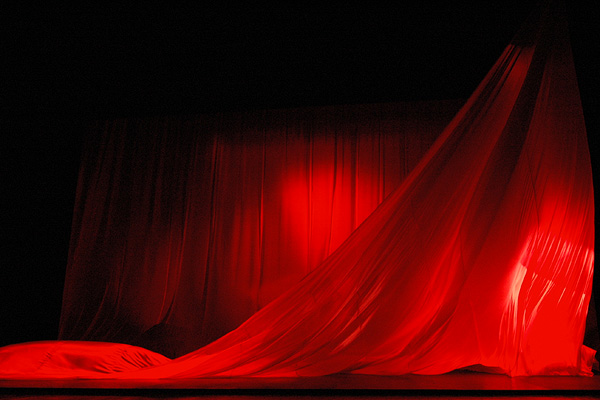
Photo © Moisés Robles
... and it is dragged upward with fluctuating movements until it disappears from the scene.
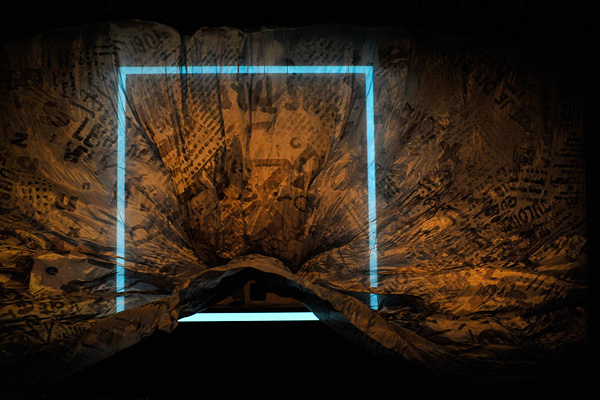
Photo © Michele Crosera / Teatro La Fenice di Venezia
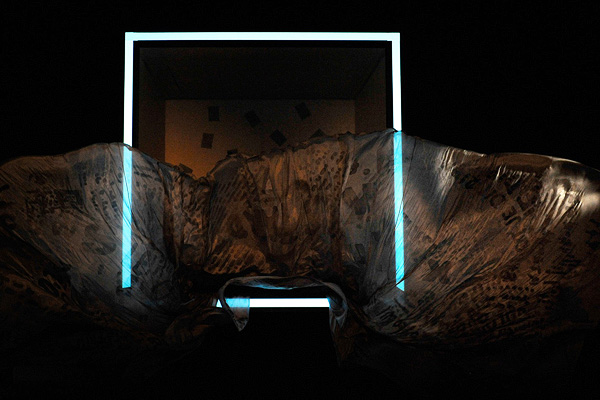
Photo © Michele Crosera / Teatro La Fenice di Venezia
... with Digital printing, width 16,8 m and height 11 m.

Photo © Luciano Romano
Teatro San Carlo, ''Paganini''
Six large semi-transparent drapes made of white HSE - Tempesta silk with concentric fullness ...

Photo © Luciano Romano
... variously moved and illuminated with chromatic light were the most visually important element of this scenography.
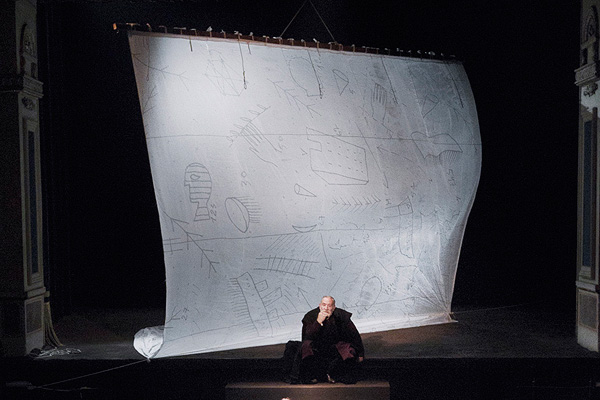
Photo © Simona Cagnasso / Teatro Stabile di Torino
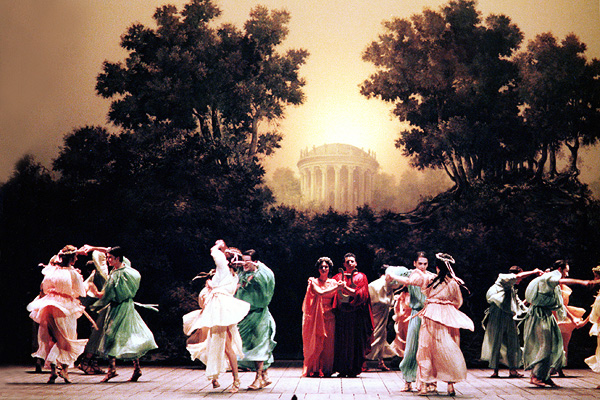
Photo © Javier del Real / Teatro Real de Madrid
Teatro Real, ''L'Orfeo''
Costumes manufactured with HSE140N - Tempesta - Not flameproof silk of several colours.
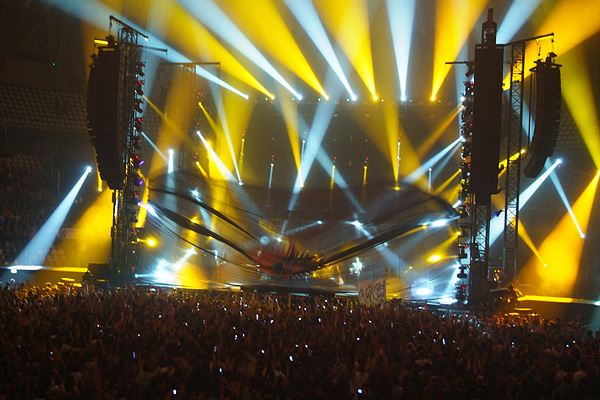
Photo © Le Grandi Immagini

Photo © Alfredo Tabocchini
Arena Sferisterio, ''Les contes d'Hoffmann''
Backdrop made of 01. white HSE - Tempesta silk.
The backdrop, installed flat and tense, thanks to the strong light reflection properties assumed with great effectiveness the colorations of the illumination: greyish in this case ...

Photo © Alfredo Tabocchini
... or blue in the scene of the famous Barcarolle.
Pier Luigi Pizzi exploited the extreme lightness of the fabric giving it a continuous superficial movement that conferred to the backdrop a swaying and amazing vitality.
Pier Luigi Pizzi exploited the extreme lightness of the fabric giving it a continuous superficial movement that conferred to the backdrop a swaying and amazing vitality.
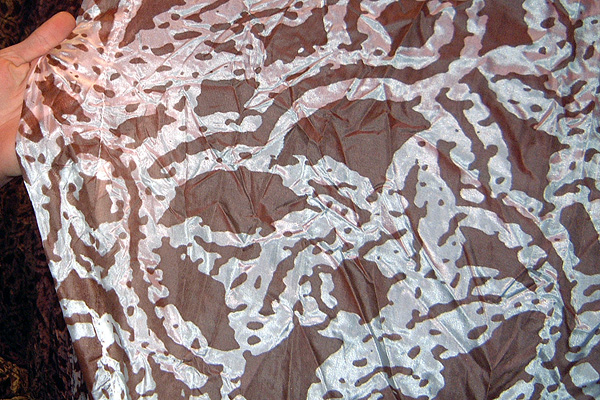
Photo © Franco Lannino - Studio Camera
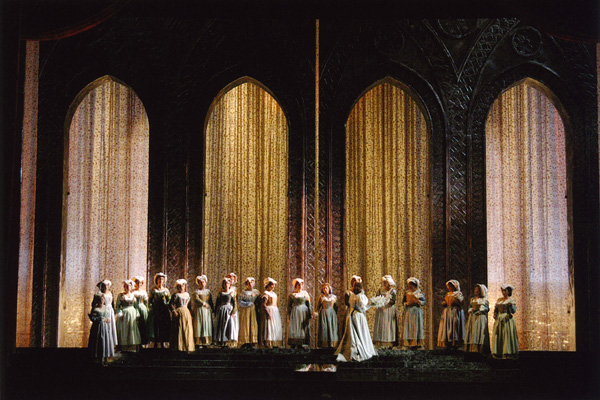
Photo © Franco Lannino - Studio Camera
... with which a large Traveller curtain with vertical fullness was made, here illuminated with yellow light, through which a sea panorama realized with silver QSK - Retrafilm is shining.