Teatro Verdi di Padova, ''Aida''

Photo © Peroni
The stage of the Teatro Verdi of Padua during the staging.
The middle of the tilted floor that occupies the whole stage opens on a big trap door that, during the opera, will disclose to the public the presence of an underlying environment.
The stage space reflects into two trapezoidal mirroring wings ...
The middle of the tilted floor that occupies the whole stage opens on a big trap door that, during the opera, will disclose to the public the presence of an underlying environment.
The stage space reflects into two trapezoidal mirroring wings ...

Photo © Peroni
... and into a ZSM - Magic Mirror backdrop 11 m high and 14 m wide that forms, in comparison to the tilted floor of the stage, an angle of 90°.
Through the ZSM - Magic Mirror one can glimpse, in transparency, something similar to a grey drapery.
It is an RAR - Arizona backdrop for rear-illumination, 9 m wide and 7 m high, still waiting for being tense to the structures of stage.
Through the ZSM - Magic Mirror one can glimpse, in transparency, something similar to a grey drapery.
It is an RAR - Arizona backdrop for rear-illumination, 9 m wide and 7 m high, still waiting for being tense to the structures of stage.

Photo © Peroni
The ZSM - Magic Mirror has been tilted in such a way to give to the public a reflected vision from a high point of view of the scenary and of the characters.
It is in evidence the mighty structure realized with some heavy-duty 7QD40 - Square trusses HD 40 cm ...
It is in evidence the mighty structure realized with some heavy-duty 7QD40 - Square trusses HD 40 cm ...

Photo © Peroni
... to which the mirror has been stretched using 500 black WPE - Perofix.
The perimeter is finished with WCS - S Strap + WOC - C Eyelets + WPE - Perofix.
The perimeter is finished with WCS - S Strap + WOC - C Eyelets + WPE - Perofix.

Photo © Peroni
Large bas-reliefs cover the inclined platform that raises the stage floor ...

Photo © Peroni
... and the foldable and practicable hatch of the trap door ...

Photo © Michele Crosera
... and will be reflected by the ZSM - Magic Mirror backdrop, as can be seen in these photographs taken during the dress rehearsals of the show.
The lights dim ...
The lights dim ...

Photo © Michele Crosera
... while Amneris's maids bring on stage two red HSE - Tempesta silk backdrops ...
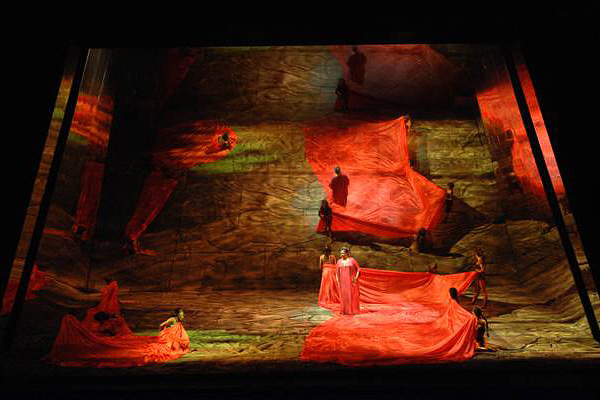
Photo © Michele Crosera
... manufactured in the dimensions of 11 x 6 m, which are unfolded and create a liquid and mobile blood cloud that duplicates itself in the mirror.
Hugo de Ana has alternated, throughout the show, the reflective characteristics of the ZSM - Magic Mirror with the transparent ones, in fact the regulation of the lighting can gradually make what is behind it appear through the mirror and, in the following image ...
Hugo de Ana has alternated, throughout the show, the reflective characteristics of the ZSM - Magic Mirror with the transparent ones, in fact the regulation of the lighting can gradually make what is behind it appear through the mirror and, in the following image ...

Photo © Michele Crosera
... in the upper left part of the image it is evident how the mirroring effect of the ZSM - Magic Mirror is slightly altered by the emergence of the presence of another bas-relief backdrop installed vertically, behind the mirroring backdrop, which was made to appear or disappear, during the unfolding of the scenes, thanks to the use of lights.
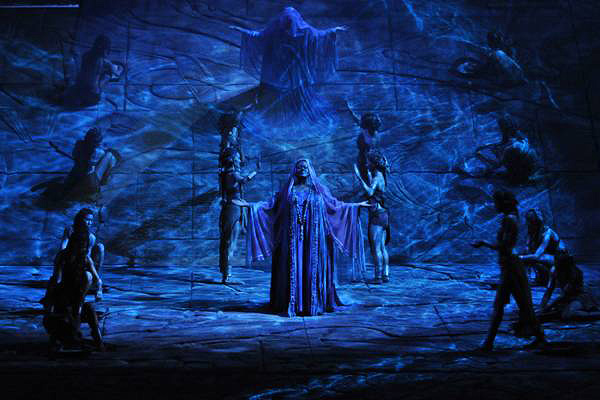
Photo © Michele Crosera
A change of scene occurs with the passage to a lighting with variegated blue light, which creates a liquid environment accentuated by the reflections coming from the mirror.
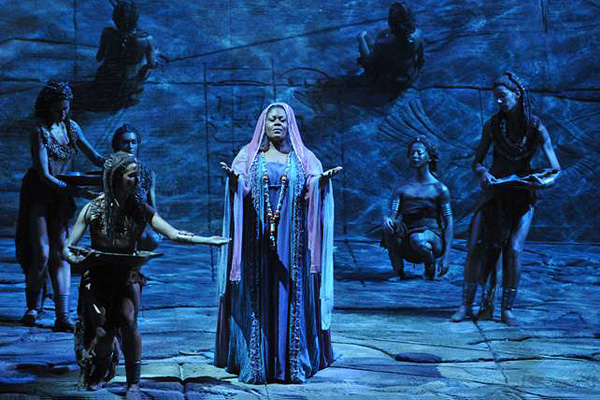
Photo © Michele Crosera
As of habit, Hugo de Ana also signed the costumes of the show - in the image those of Amneris and of the handmaids - and worked with the choreographer Leda Lojodice.
The scene is about to change again, behind the ZSM - Magic Mirror are ...
The scene is about to change again, behind the ZSM - Magic Mirror are ...
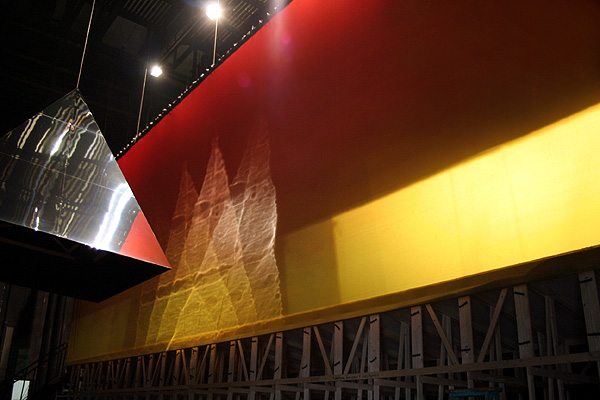
Photo © Peroni
... a suspended pyramid and a RNB - Nebbia digital printing backdrop, 15 x h 5.5 m, here illuminated with yellow light.
The print fades in colour from a totally neutral colour on the bottom to red on the top.
With a change in light ...
The print fades in colour from a totally neutral colour on the bottom to red on the top.
With a change in light ...
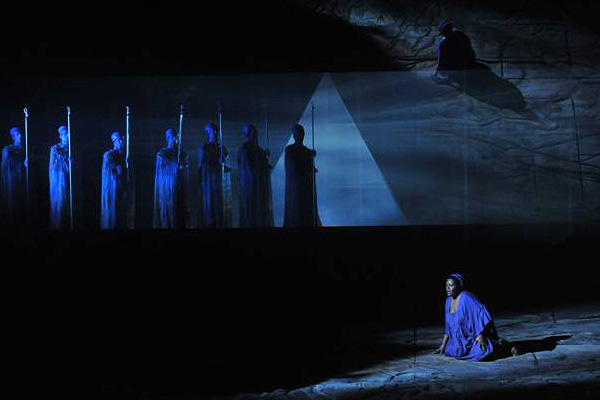
Photo © Michele Crosera
... the mirror will become transparent and reveal the row of characters in the background, on the left, who are behind it, together with the pyramid.
In the upper right corner, however, thanks to the localized lighting in front of the mirror, the image of Amneris kneeling in the foreground can be seen reflected in a blurred way.
In the upper right corner, however, thanks to the localized lighting in front of the mirror, the image of Amneris kneeling in the foreground can be seen reflected in a blurred way.
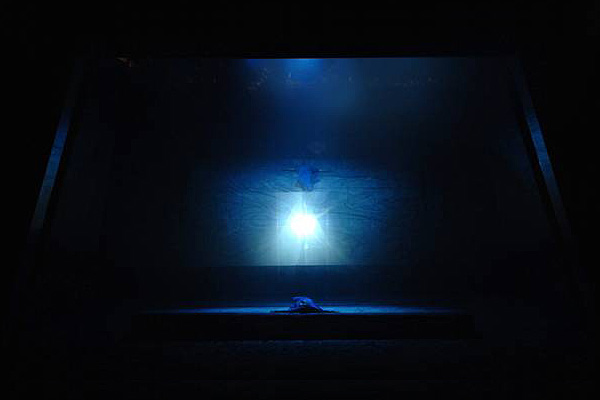
Photo © Michele Crosera
Amneris, lying down on her back on the stage, reflects herself on the ZSM - Magic Mirror, through which it shines the light reflected by the pyramid that is suspended behind the backdrop creating a fading effect.

Photo © Michele Crosera
The opening of the trap door makes raise on the mirror the image of Amneris ...
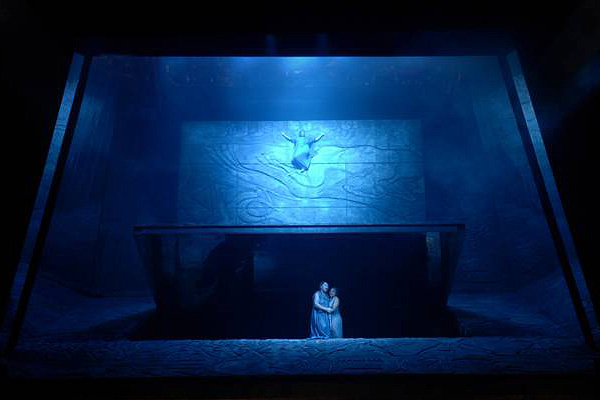
Photo © Michele Crosera
... who is here laying on the earth while ...
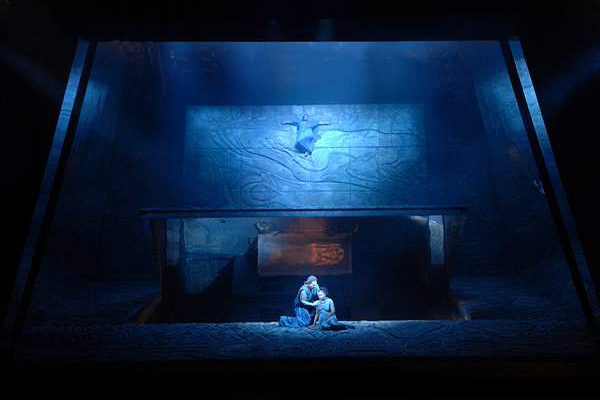
Photo © Michele Crosera
... on the mirroring surface of the inferior side of the cover, it appears reflected the image of a sarcophagus (made with a Digital printing on the special ASC - Sceno digital printing fabric), that is set in the crypt ...

Photo © Michele Crosera
... where the protagonists will die.
The lights change again, the bas-relief backdrop is lowered behind the mirror, which is illuminated with grazing light, and the image of Amneris reflected in the mirror is replaced ...
The lights change again, the bas-relief backdrop is lowered behind the mirror, which is illuminated with grazing light, and the image of Amneris reflected in the mirror is replaced ...

Photo © Michele Crosera
... from that of the bas-relief, here visible in transparency.
The image of the sarcophagus has been replaced by a perspective view from below of the gigantic columns of an Egyptian temple (the temple of Vulcan, according to the plot of the libretto), a view that has been printed in Digital printing on an 8.5 x 5 m floor made of ASC - Sceno digital printing muslin.
The trap door is then closed ...
The image of the sarcophagus has been replaced by a perspective view from below of the gigantic columns of an Egyptian temple (the temple of Vulcan, according to the plot of the libretto), a view that has been printed in Digital printing on an 8.5 x 5 m floor made of ASC - Sceno digital printing muslin.
The trap door is then closed ...
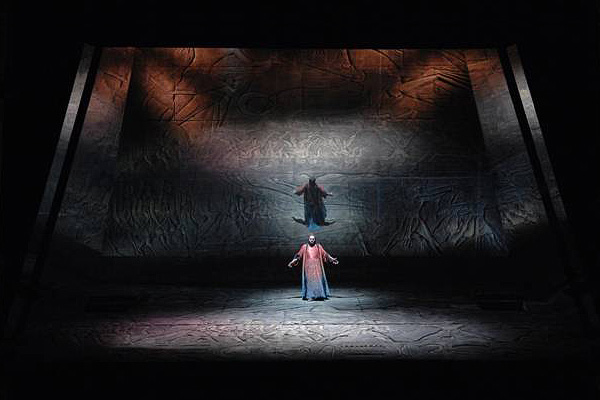
Photo © Michele Crosera
... and here, on the ZSM - Magic Mirror backdrop, the area with a grey light that surrounds Radames is, evidently, a reflection of the floor of the stage.
The brown aura that overhangs and surrounds the grey zone is constituted, instead, by the backdrop in bas-relief that, opportunely illuminated ...
The brown aura that overhangs and surrounds the grey zone is constituted, instead, by the backdrop in bas-relief that, opportunely illuminated ...
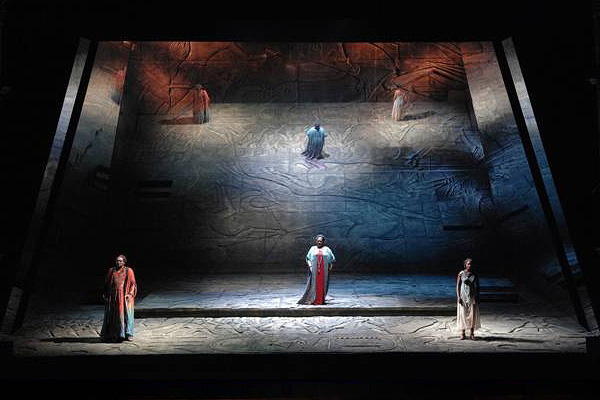
Photo © Michele Crosera
... it is seen in transparency through the mirror.
The colours of the lights are then reversed …
The colours of the lights are then reversed …

Photo © Michele Crosera
... and here it is the characters and the stage floor that are illuminated with brown light, while the grey light projected on the bas-relief makes it to appear through the lower part of the mirror.
To notice as, in the area of transition among the transparency and the reflected image, are slightly visible the two small trap doors opened on the sides of the floor of the stage.
To notice as, in the area of transition among the transparency and the reflected image, are slightly visible the two small trap doors opened on the sides of the floor of the stage.
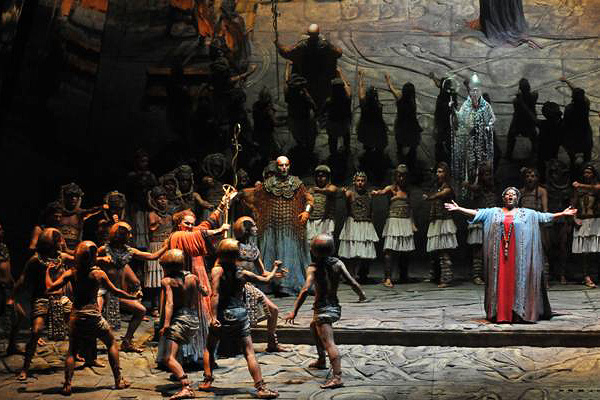
Photo © Michele Crosera
Here instead it is remarkable as, among the real image and that reflected one of Radames, one can glimpse on the mirror a character - probably the Gran Priest Ramfis - that is not reflected, but it is behind it, and he is made to appear through the backdrop with the use of a located illumination.
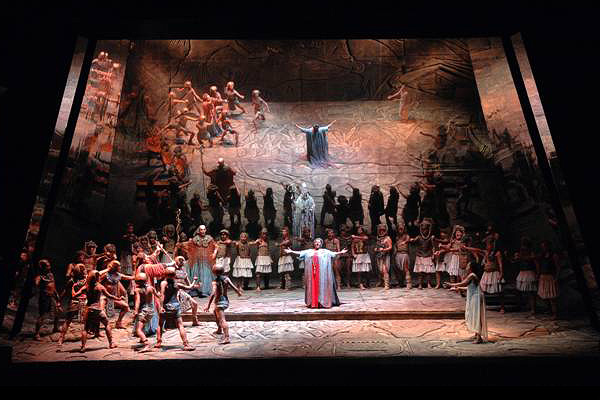
Photo © Michele Crosera
The use that Hugo de Ana made here of the side mirrors is similar to that often used by Beni Montresor with the intent to dilate the space of the stage.
Actually, De Ana uses the mirroring surfaces for a proper and different purpose, that is that to build a tied up symbolic-esoteric game to the Egyptian location of the opera ...
Actually, De Ana uses the mirroring surfaces for a proper and different purpose, that is that to build a tied up symbolic-esoteric game to the Egyptian location of the opera ...

Photo © Michele Crosera
... because the stage space results so to be transposed inside a pyramid of which the vertex is not visible.
All the slaves climbed now on the tilted floor and they are standing on the border of the illuminated area of the stage space, doing so that their image is glimpse, on the backdrop, in the area of transition between the reflection and the transparence.
All the slaves climbed now on the tilted floor and they are standing on the border of the illuminated area of the stage space, doing so that their image is glimpse, on the backdrop, in the area of transition between the reflection and the transparence.

Photo © Michele Crosera
In the upper part of the image, proceeding to the right from left, the reflecting effect of the ZSM - Magic Mirror backdrop is dissolved in the transparency through which the bas-relief appears on the surface, because of the hedgetop light, assuming the maximum evidence on the top right corner of the picture.
The illumination of the bas-relief set behind the mirror makes it appear in transparency, on the higher part of the backdrop ...
The illumination of the bas-relief set behind the mirror makes it appear in transparency, on the higher part of the backdrop ...
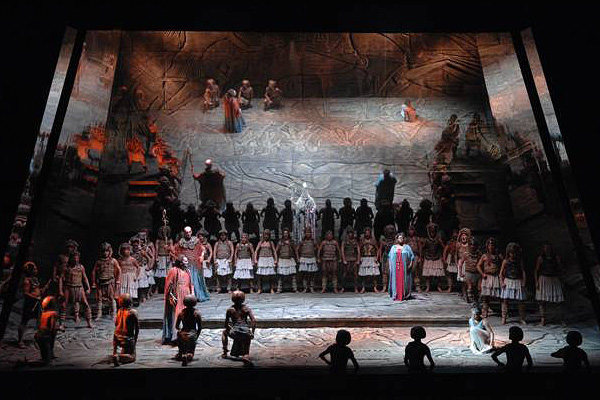
Photo © Michele Crosera
... totally replacing it with the image reflected of the slaves that, in the foreground, of back they are found back-lighted on the right of the proscenium, out of the illuminated area of the stage.
The slaves' illumination with located light would make them appear in superimpression on the right of the upper part of the ZSM - Magic Mirror backdrop.
The slaves' illumination with located light would make them appear in superimpression on the right of the upper part of the ZSM - Magic Mirror backdrop.