Luciano Damiani
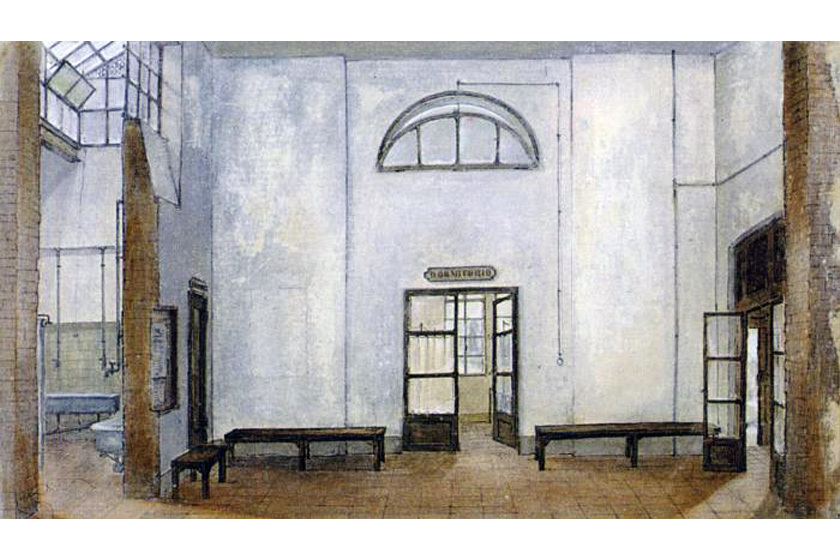
Photo © Luciano Damiani / Piccolo Teatro di Milano
Piccolo Teatro, ''El nost Milan'', 1955
The work that for more than twenty years Luciano Damiani develops beside Giorgio Strehler at the Piccolo Teatro contributes to do of it one of the more important theatrical institutions to the world.
Amongst the installations that he realized, littre by little more stylized and innovative ...
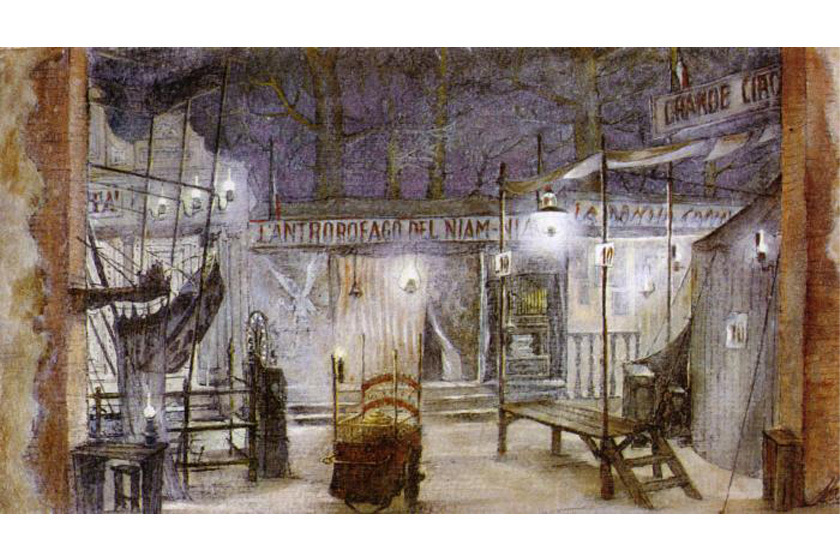
Photo © Luciano Damiani / Piccolo Teatro di Milano
... one must mention at least:
El nost Milan, 1955 / 1956
The Good Person of Szechwan, 1957 / 1958
Piccolo Teatro, ''Life of Galileo'', 1961 / 1962
Le baruffe chiozzotte, 1964 / 1965
Piccolo Teatro, ''The Cherry Orchard'', 1973-74
Il campiello, 1974 / 1975
Piccolo Teatro, ''The Tempest'', 1977 / 1978
El nost Milan, 1955 / 1956
The Good Person of Szechwan, 1957 / 1958
Piccolo Teatro, ''Life of Galileo'', 1961 / 1962
Le baruffe chiozzotte, 1964 / 1965
Piccolo Teatro, ''The Cherry Orchard'', 1973-74
Il campiello, 1974 / 1975
Piccolo Teatro, ''The Tempest'', 1977 / 1978
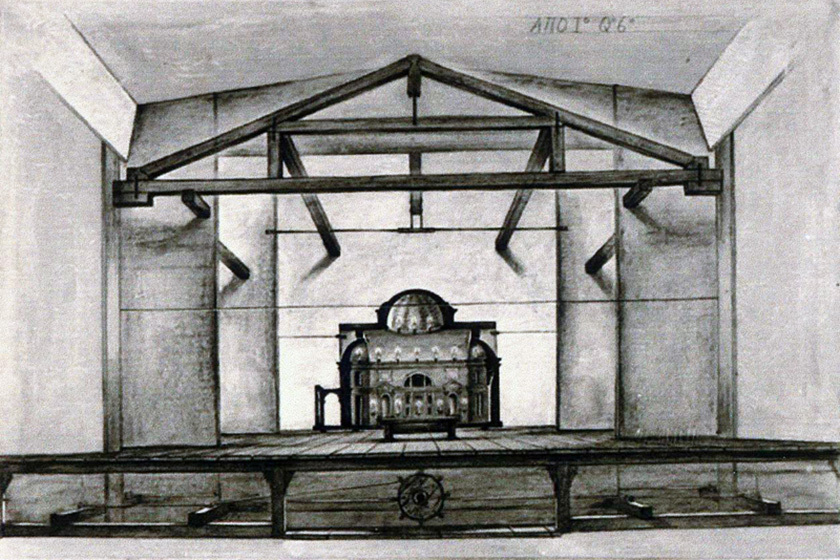
Photo © Piccolo Teatro di Milano
Piccolo Teatro, ''Life of Galileo'', 1961
Luciano Damiani recalls in Curtains of a self-portrait:
«In Life of Galileo the scene began out of the stage and a truss drawn by Leonardo da Vinci framed the portal aloft.
Under the front of the stage ...»
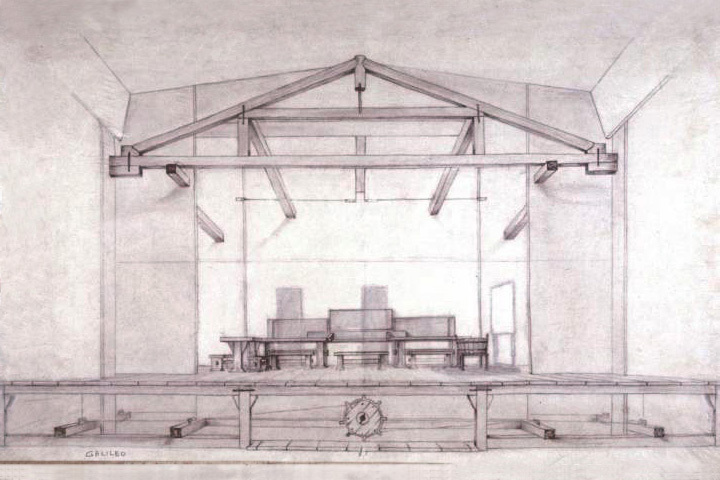
Photo © Piccolo Teatro di Milano
«... the machine of the curtain by Nicola Sabbatini, scenographer of the seventeenth century.
The stage floor was the only perspective element, with an accented inclination in the container with orthogonal plan.
Five beams departed from the truss ...»
The stage floor was the only perspective element, with an accented inclination in the container with orthogonal plan.
Five beams departed from the truss ...»
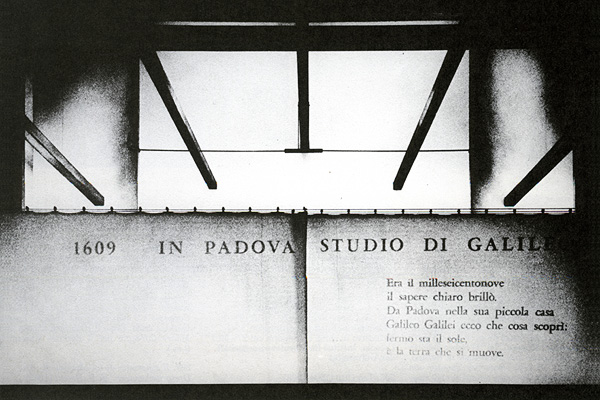
Photo © Piccolo Teatro di Milano
«... to end against the wall in the background.
The one in the middle was calculated so that they all five resulted similar in the volume.
The purpose was to avoid the ''protagonism'' of the central beam that one can find in Paolo Uccello's works.
The scene had to result to the eye of the audience ...»
The one in the middle was calculated so that they all five resulted similar in the volume.
The purpose was to avoid the ''protagonism'' of the central beam that one can find in Paolo Uccello's works.
The scene had to result to the eye of the audience ...»
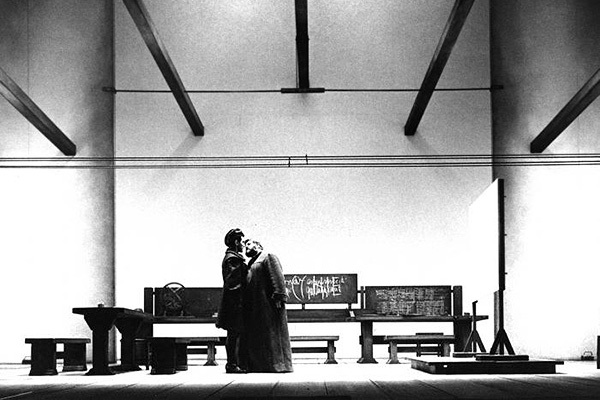
Photo © Piccolo Teatro di Milano
«... on the same level, like a ''sheet of paper'' where the characters would be hacked without their own shades and without brought shades, and this was the idea and the great difficulty, but also the beauty.»
At the end of the Sixties Damiani has frequent and not concretized contacts ...
At the end of the Sixties Damiani has frequent and not concretized contacts ...
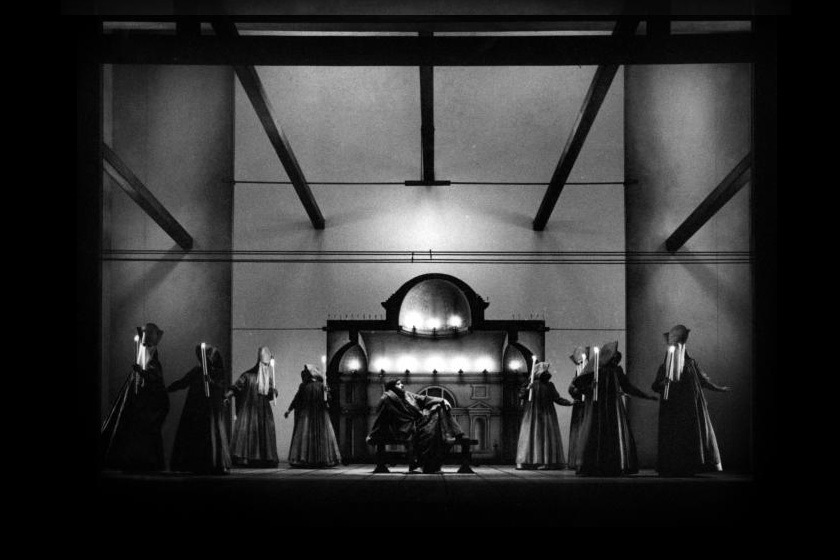
Photo © Mario Mulas / Piccolo Teatro di Milano
... with the cinema.
Federico Fellini would like to submit him the scenography of his famous unrealized movie, Il viaggio di Mastorna.
Peter Glenville calls him for The Man of the Mancha, but after some pre-production tests the project is abandoned, however, during the tests for the scenography Damiani experiments a large semi-transparent silk veil ...
Federico Fellini would like to submit him the scenography of his famous unrealized movie, Il viaggio di Mastorna.
Peter Glenville calls him for The Man of the Mancha, but after some pre-production tests the project is abandoned, however, during the tests for the scenography Damiani experiments a large semi-transparent silk veil ...
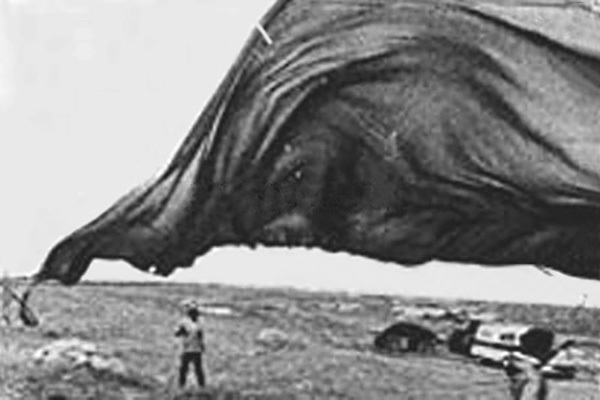
Photo © Unknown
... hovering in the wind.
The idea is not appreciated, but not all is lost, because the veil will often appear in Damiani's next production, becoming almost an obsession.
Damiani himself includes it in a graphic representation of his scenographic and theatrical conception in which the silk veil of The Man of La Mancha has a position of absolute importance.
The idea is not appreciated, but not all is lost, because the veil will often appear in Damiani's next production, becoming almost an obsession.
Damiani himself includes it in a graphic representation of his scenographic and theatrical conception in which the silk veil of The Man of La Mancha has a position of absolute importance.
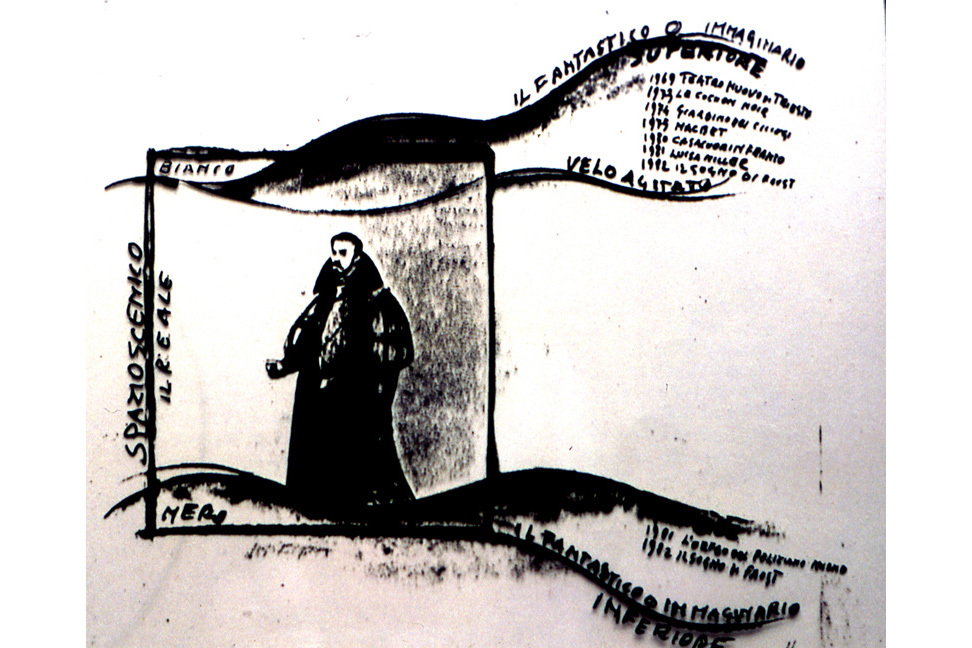
Photo © Daniele Paolin (raccolta personale)
Damiani puts in fact the stage space between ''the upper fantastic or imaginary'' represented by a shaken white veil, and ''the lower fantastic or imaginary'', identified with the black, placing its projects between the two limits from 1969 onwards.
«A synthesis of his own aesthetical theories applied to the theater that Damiani held really dear», Daniele Paolin states, he's a stage designer and scenography teacher who was a student of Damiani.
«A synthesis of his own aesthetical theories applied to the theater that Damiani held really dear», Daniele Paolin states, he's a stage designer and scenography teacher who was a student of Damiani.
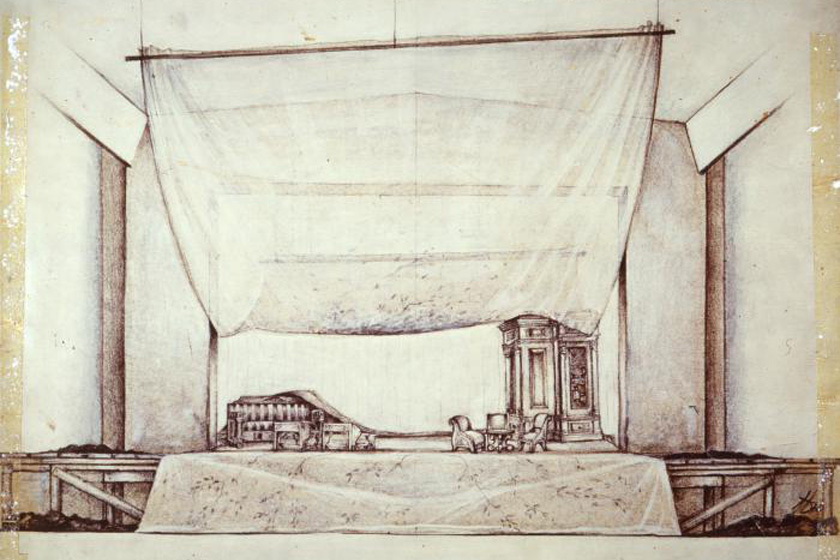
Photo © Luciano Damiani / Piccolo Teatro di Milano
Piccolo Teatro, ''The Cherry Orchard'', 1973
And here is a famous scenographic implementation of the theories.
An ethereal backdrop of white silk lifts from the back of the stage, entirely covers it and expands up to the ceiling of the stalls (the suspended veil), while another backdrop of clear fabric ...
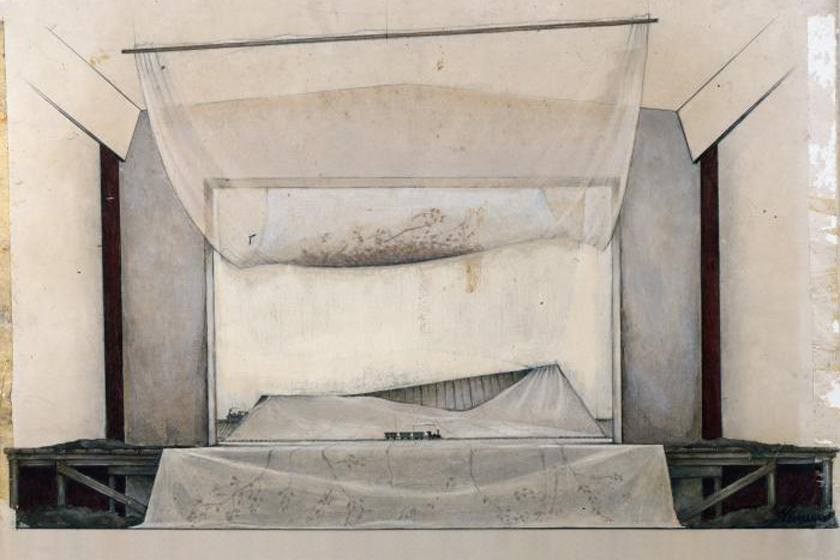
Photo © Luciano Damiani / Piccolo Teatro di Milano
... goes down like a fall from the front of the stage.
Daniele Paolin goes on:
«After having used in different installations the suspended veil for the ''upper fantastic'', and symbolized the ''real'' with the space in an orthogonal layout, Damiani will succeed in realizing in 1983 the flexible plane, the theatrical machine with which he will also reproduce the ''lower fantastic'' in the way that he will consider ideal.»
Daniele Paolin goes on:
«After having used in different installations the suspended veil for the ''upper fantastic'', and symbolized the ''real'' with the space in an orthogonal layout, Damiani will succeed in realizing in 1983 the flexible plane, the theatrical machine with which he will also reproduce the ''lower fantastic'' in the way that he will consider ideal.»
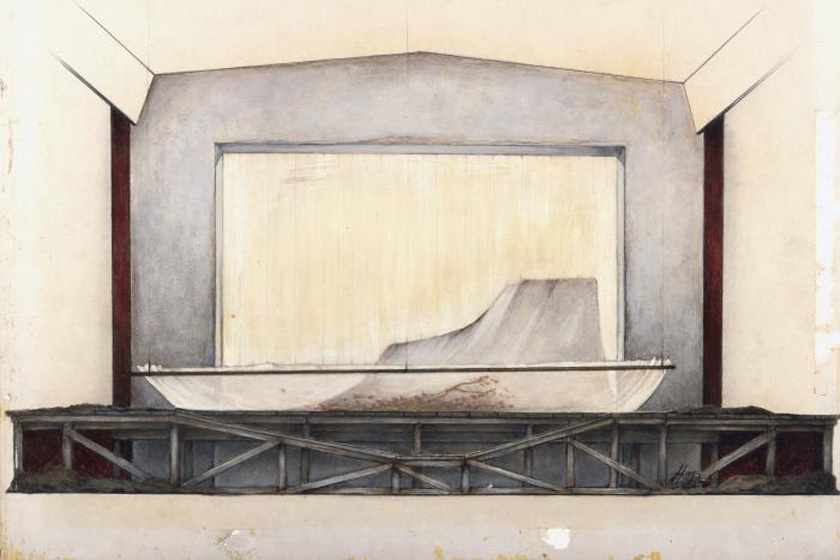
Photo © Luciano Damiani / Piccolo Teatro di Milano
«But it is in 1987, with Orfeo ed Euridice of Teatro Regio of Parma, that Damiani will hold to have brought really to conclusion his artistic run, because, he will finally succeed in gathering all the three elements.»
The three elements become almost an expressive recurrence of the maturity of Luciano Damiani who remembers:
«Seven years later [1980, editor's note] the suspended veil ...»
The three elements become almost an expressive recurrence of the maturity of Luciano Damiani who remembers:
«Seven years later [1980, editor's note] the suspended veil ...»
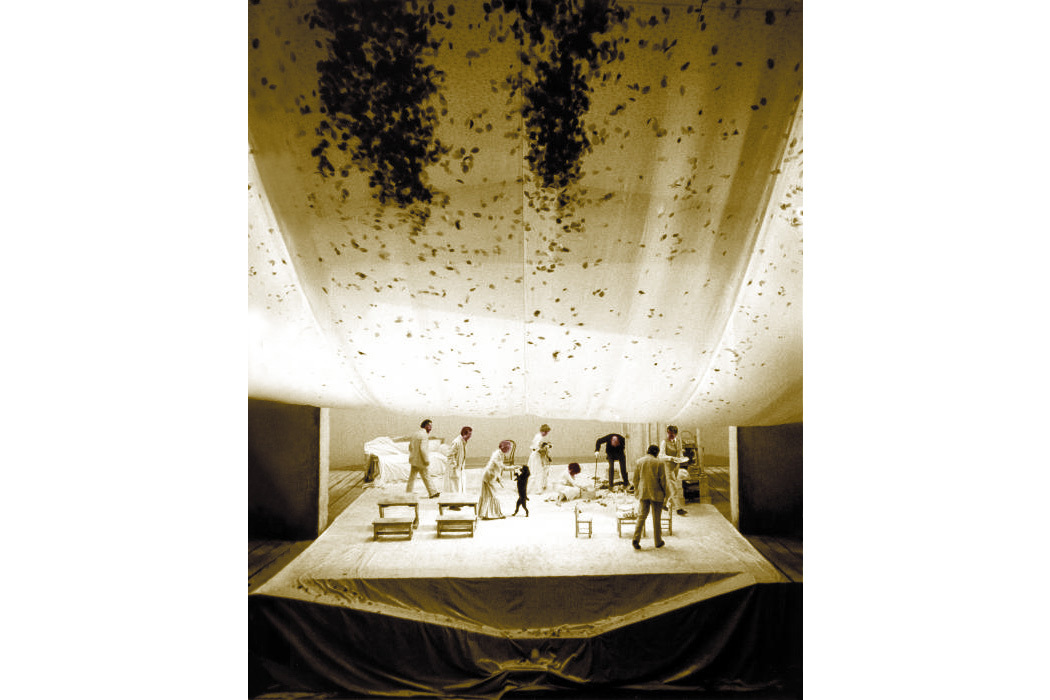
Photo © Luigi Ciminaghi / Piccolo Teatro di Milano
«... will return to dominate at the Teatro Argentina in Heartbreak House, with the direction by Luigi Squarzina, where also the steep floor of the stage was destined to a symbolic instability as the deck of the ship.»
How Daniele Paolin explains:
«The ''real'' and the ''lower'' and ''upper'' fantastics are spatial entity ...»
How Daniele Paolin explains:
«The ''real'' and the ''lower'' and ''upper'' fantastics are spatial entity ...»
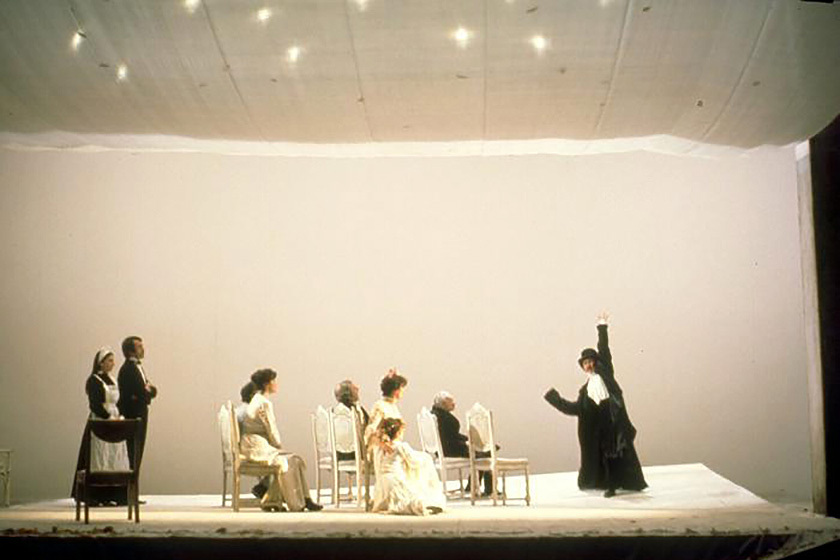
Photo © Luigi Ciminaghi / Piccolo Teatro di Milano
«... that already belonged to the Baroque Italian theater - with the differences of the case, obviously - but not only:
the English Renaissance stage of the public theaters, for instance, already was ideally separated in the three poetically well defined zones.
There was in fact a ''stage'', situated probably to the height of the heads of the spectators; the height depended on the needs of good visibility, but it was also useful to assure enough space to the position of the so-called ''hell'' ...»
the English Renaissance stage of the public theaters, for instance, already was ideally separated in the three poetically well defined zones.
There was in fact a ''stage'', situated probably to the height of the heads of the spectators; the height depended on the needs of good visibility, but it was also useful to assure enough space to the position of the so-called ''hell'' ...»
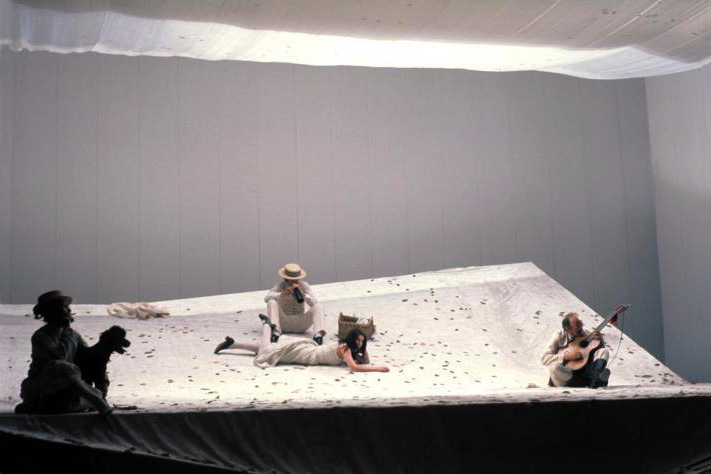
Photo © Luigi Ciminaghi / Piccolo Teatro di Milano
«... situated under the floor of the stage and from which devils and other demoniac apparitions got out through the use of one or more trap doors.
The ''stage'', then, was partially covered by a roof said ''heavens'':
Here, with all probability, the machineries for the supernatural descents of the divinities were situated.
The ''stage'' was the ''real'', the other two spaces can be compared to the ''fantastics'', the lower, ''hell'', and the upper, ''heavens''.»
The ''stage'', then, was partially covered by a roof said ''heavens'':
Here, with all probability, the machineries for the supernatural descents of the divinities were situated.
The ''stage'' was the ''real'', the other two spaces can be compared to the ''fantastics'', the lower, ''hell'', and the upper, ''heavens''.»
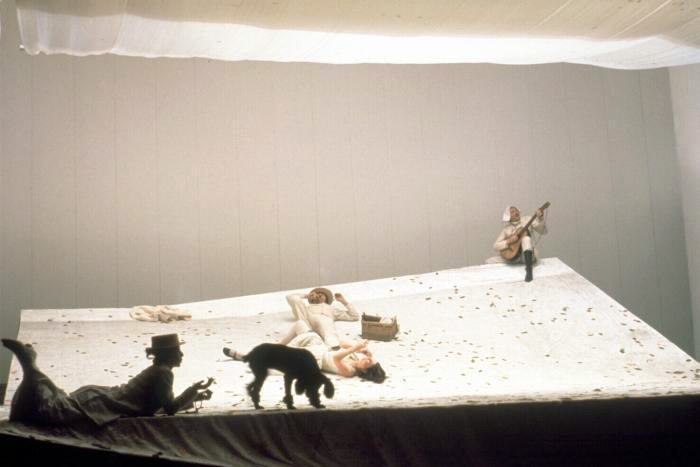
Photo © Luigi Ciminaghi / Piccolo Teatro di Milano
One of the best known declarations of Luciano Damiani is the one in which he argues that:
«... one mustn't decorate the space, but structure it.»
And his spaces are often rarefied, essential, almost endowed with a hypnotic call.
He gets to use the void as a poetry of the mise en scène:
«My most beautiful scenographies ...»
«... one mustn't decorate the space, but structure it.»
And his spaces are often rarefied, essential, almost endowed with a hypnotic call.
He gets to use the void as a poetry of the mise en scène:
«My most beautiful scenographies ...»
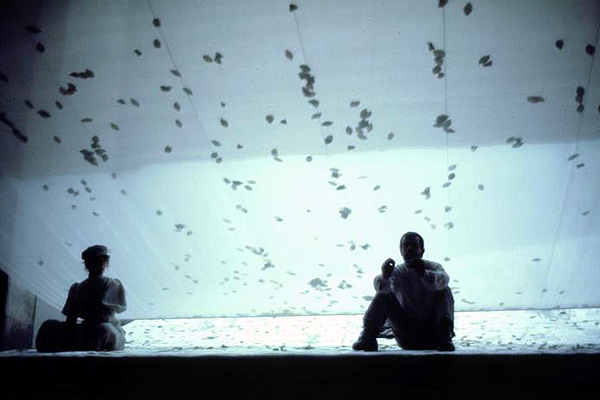
Photo © Luigi Ciminaghi / Piccolo Teatro di Milano
«... are made of silences.»
His stage elaborations are often so connatural to the dramaturgy of the text to make their whole inextricable.
In the opera theater Damiani arrives to use the visual space to mark with the rhythm and to accompany the musical time.
The veil of Man of La Mancha is at the origins ...
His stage elaborations are often so connatural to the dramaturgy of the text to make their whole inextricable.
In the opera theater Damiani arrives to use the visual space to mark with the rhythm and to accompany the musical time.
The veil of Man of La Mancha is at the origins ...
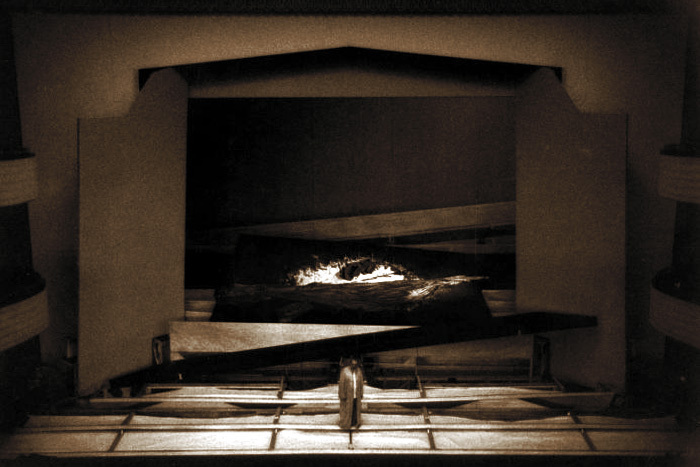
Photo © Luigi Ciminaghi / Piccolo Teatro di Milano
Piccolo Teatro, ''The Tempest'', 1977
... of the scenography of another historical staging by Strehler and the Piccolo Teatro, as Damiani himself tells:
«I made, for the folly of Don Quixote, a ''tempest'' with a huge veil of silk held up by a tall crane and hovered to the wind.»
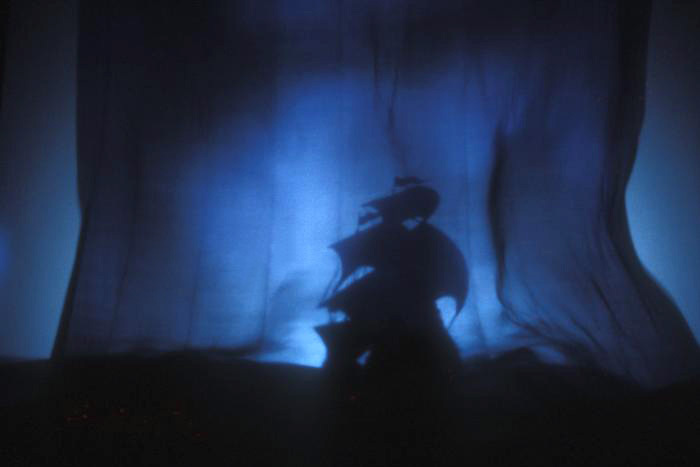
Photo © Luigi Ciminaghi / Piccolo Teatro di Milano
«The result was exciting.
For the film it was not used because of the seams that were contested by the supervisors, but that veil entered with overbearance the history of theater.
The idea to represent the folly of Don Quixote through an immense tempestuous veil, in an open space, as in the grim atmospheres of certain etching by Goya, associate itself to that of the ceiling stretched out in the hall of the project of the Teatro di Trieste, that will characterize from now on, the space for excellence of the imagination.»
For the film it was not used because of the seams that were contested by the supervisors, but that veil entered with overbearance the history of theater.
The idea to represent the folly of Don Quixote through an immense tempestuous veil, in an open space, as in the grim atmospheres of certain etching by Goya, associate itself to that of the ceiling stretched out in the hall of the project of the Teatro di Trieste, that will characterize from now on, the space for excellence of the imagination.»
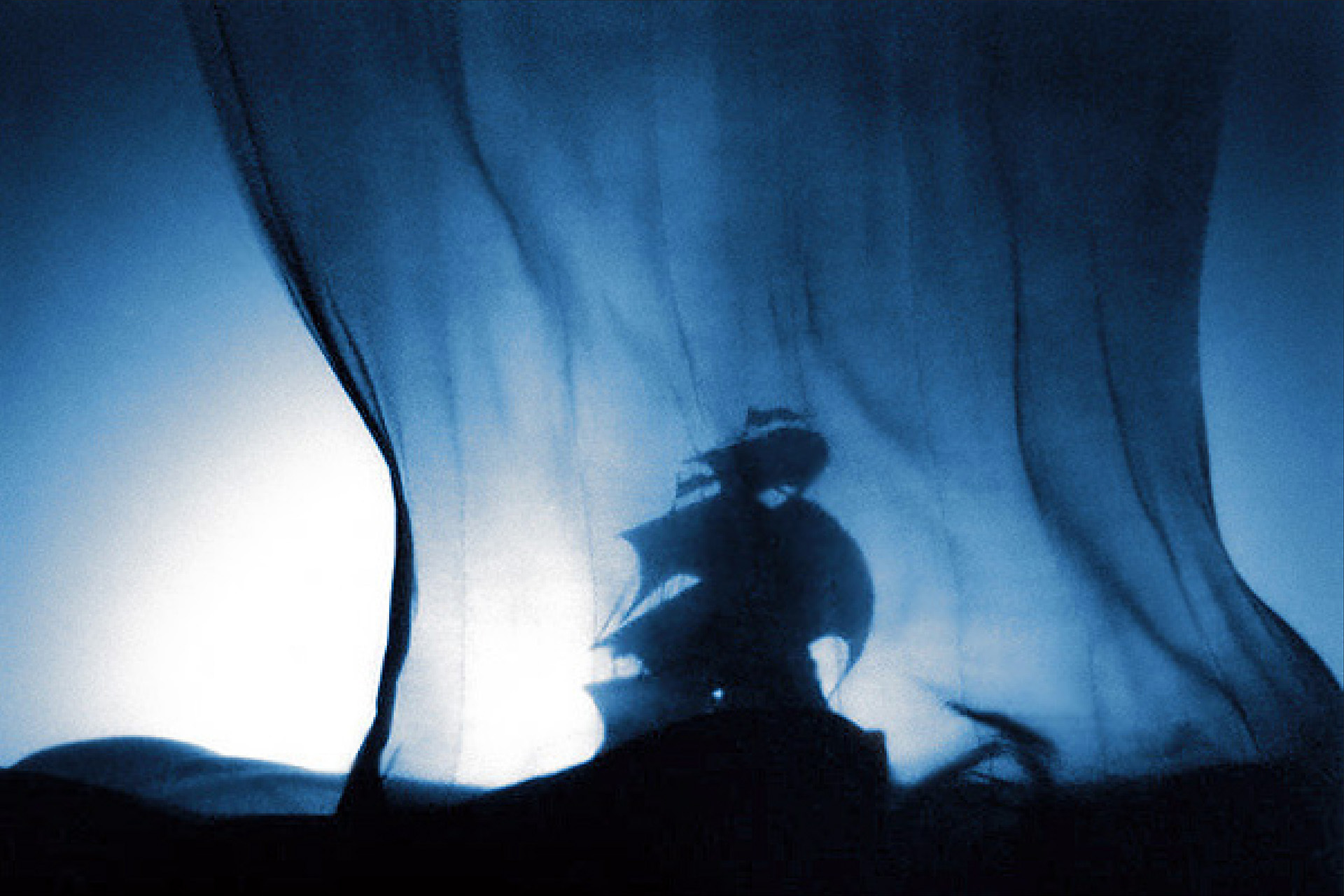
Photo © Luigi Ciminaghi / Piccolo Teatro di Milano
The scenography of The Tempest in Damiani's intentions:
«... underlined, once again, my adversity to the war.
From the dark sea, the sea of the evil that was present in the whole show, the monster, symbol of the war that scatters dead bodies, went out ... then the final utopia: the warriors threw away the weapons.»
«... underlined, once again, my adversity to the war.
From the dark sea, the sea of the evil that was present in the whole show, the monster, symbol of the war that scatters dead bodies, went out ... then the final utopia: the warriors threw away the weapons.»
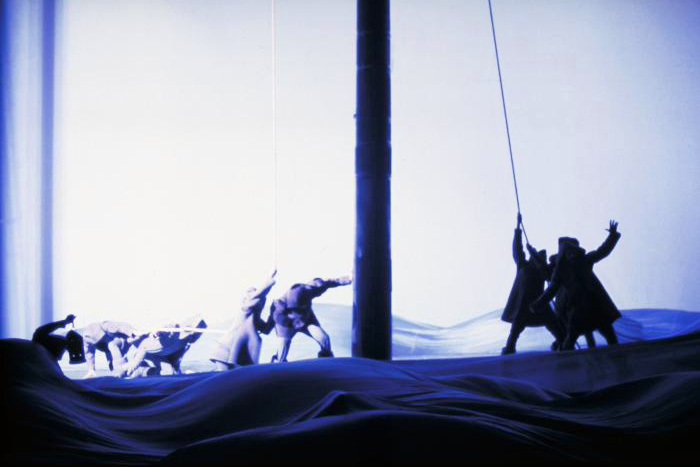
Photo © Luigi Ciminaghi / Piccolo Teatro di Milano
Gradually the relationships with Giorgio Strehler and Paolo Grassi, who sometimes take possession of Damiani's ideas without recognizing their source, become more and more tense to the point of spoiling.
The recognition for himself, but for the scenographers and costume designer of the rauthor's right and the right to the social contribution will become the object of a struggle that will endure until the last years of his life.
The recognition for himself, but for the scenographers and costume designer of the rauthor's right and the right to the social contribution will become the object of a struggle that will endure until the last years of his life.
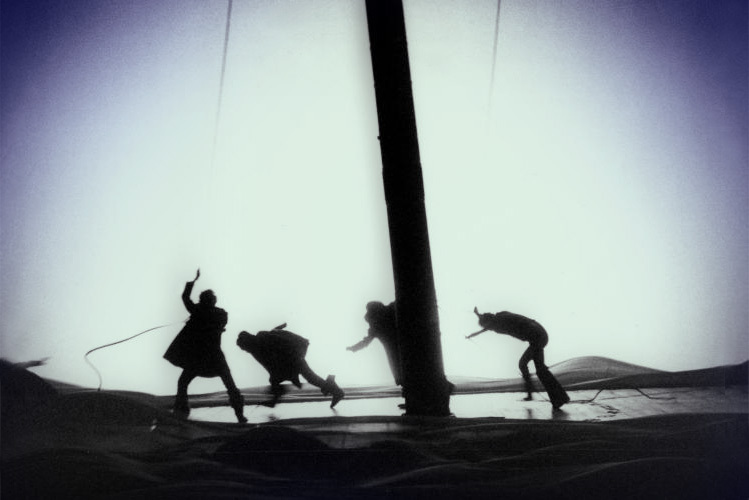
Photo © Luigi Ciminaghi / Piccolo Teatro di Milano
His vision of the scenography is so wide to invade or at times even to condition the spaces of the stage direction.
The origin of the relationship difficulties with Strehler, who was on a side happy to use LucianoDamiani's intuitions, on the other side he was irritated for his interventions and claims ...
The origin of the relationship difficulties with Strehler, who was on a side happy to use LucianoDamiani's intuitions, on the other side he was irritated for his interventions and claims ...
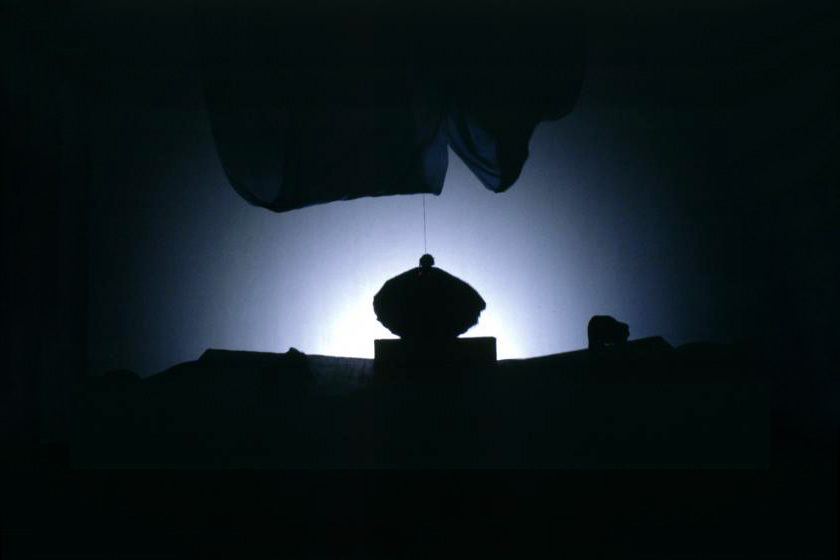
Photo © Luigi Ciminaghi / Piccolo Teatro
... is traceable perhaps really in his ingeniousness, to which he will give outlet in the numerous occasions in which the complete management of stage direction and design will be submitted to him.
Beyond any other consideration, the association of Strehler with Damiani is considered among those that ...
Beyond any other consideration, the association of Strehler with Damiani is considered among those that ...
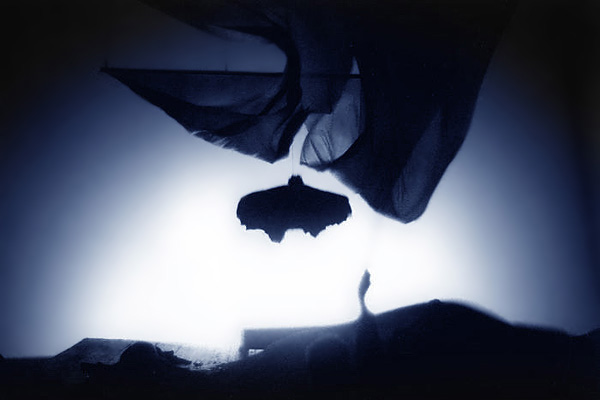
Photo © Luigi Ciminaghi / Piccolo Teatro di Milano
... in modern theater, gave absolutely the most notable results.
«I wouldn't like that you had the suspect that I'm trying to deny the credits of Paolo Grassi or of Giorgio Strehler, absolutely I'm not doing that.
I wouldn't probably have succeeded in the theatrical field if I had not met Strehler and perhaps I would never have become a show-worker if I hadn't met Grassi.»
«I wouldn't like that you had the suspect that I'm trying to deny the credits of Paolo Grassi or of Giorgio Strehler, absolutely I'm not doing that.
I wouldn't probably have succeeded in the theatrical field if I had not met Strehler and perhaps I would never have become a show-worker if I hadn't met Grassi.»
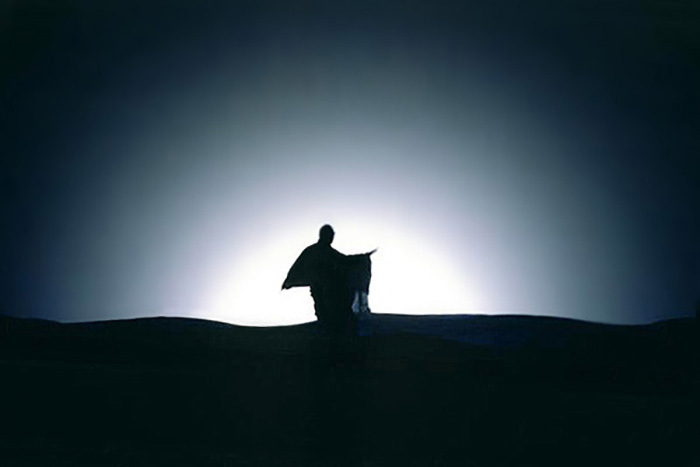
Photo © Luigi Ciminaghi / Piccolo Teatro di Milano
«The fate wanted that our roads met in certain circumstances and since I believe that each of us had something to say, we beloved, hated, but at the end esteemed each other.»
The controversies with Strehler are an almost paradigmatic constant of the difficult relationship between artists with strong personalities, also conditioned by the fact that Damiani did not accept discrimination between the role of director and that of set designer.
The controversies with Strehler are an almost paradigmatic constant of the difficult relationship between artists with strong personalities, also conditioned by the fact that Damiani did not accept discrimination between the role of director and that of set designer.
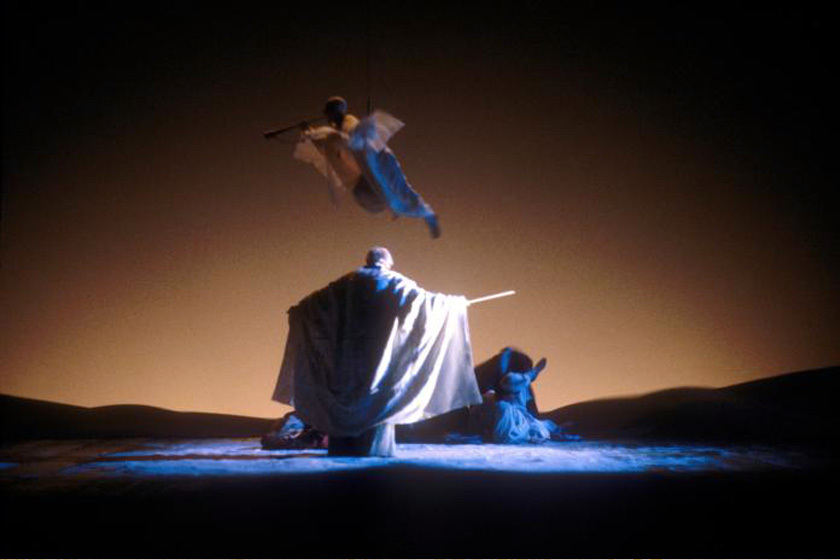
Photo © Luigi Ciminaghi / Piccolo Teatro di Milano
Discriminations that sometimes did not even come from Strehler, but from the lack of understanding of the importance of this role by the critics:
«Roberto De Monticelli, a critic of Corriere della Sera, found incorrect that I used the veil of the The Cherry Orchard by Strehler for Heartbreak House.
Why, I answered, when I conceived The Cherry Orchard for Strehler ...»
«Roberto De Monticelli, a critic of Corriere della Sera, found incorrect that I used the veil of the The Cherry Orchard by Strehler for Heartbreak House.
Why, I answered, when I conceived The Cherry Orchard for Strehler ...»
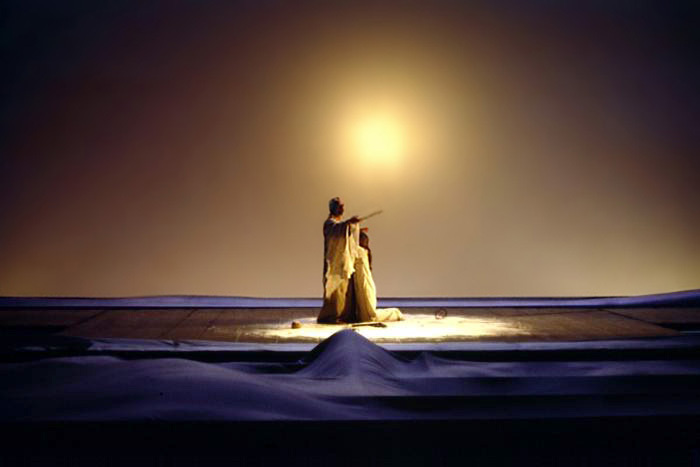
Photo © Luigi Ciminaghi / Piccolo Teatro di Milano
«... nobody remembered if it was legitimate or not that I used the same elements that I had used one year before in the scene for the Cochon noir by Roger Planchon?
These elements were in their turn inherent the project of the Teatro Nuovo of Trieste, more than belonging to some other experiences of mine concerning the fantastic.
And what to say about my scenography and costumes of The Misanthrope directed by Squarzina, inherited by Strehler for The Miser?»
These elements were in their turn inherent the project of the Teatro Nuovo of Trieste, more than belonging to some other experiences of mine concerning the fantastic.
And what to say about my scenography and costumes of The Misanthrope directed by Squarzina, inherited by Strehler for The Miser?»
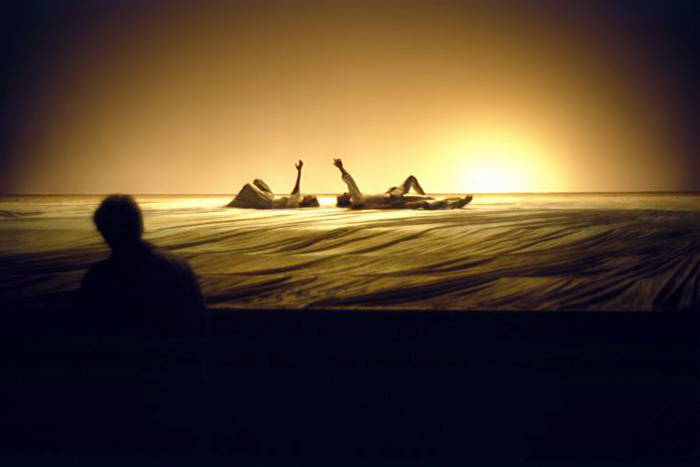
Photo © Luigi Ciminaghi / Piccolo Teatro di Milano
Also in the opera, the Strehler-Damiani binomial, always with the conflicting modalities that characterized their relationship, produced some of the best installations ever made, among which:
The Abduction from the Seraglio, 1964, for the Salzburg Festival;
The Love for Three Oranges and Macbeth, 1975, for the Teatro alla Scala.
Among the important collaborations with other directors ...
The Abduction from the Seraglio, 1964, for the Salzburg Festival;
The Love for Three Oranges and Macbeth, 1975, for the Teatro alla Scala.
Among the important collaborations with other directors ...
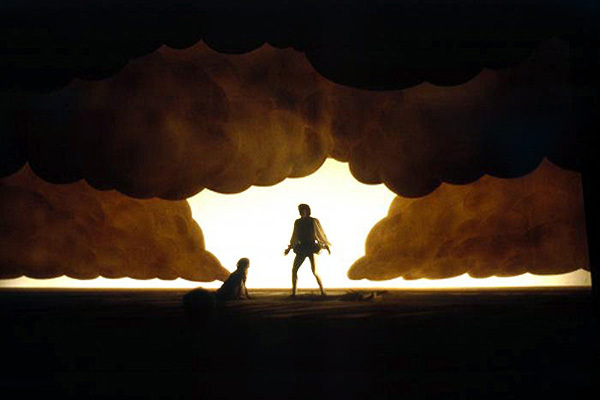
Photo © Luigi Ciminaghi / Piccolo Teatro di Milano
... one must remember those with Luca Ronconi, to whom he's tied by friendship too.
With him he realizes, amongst the others:
The Birds, 1975, and Oresteia, 1976, for the Burgtheater of Vienna;
Don Carlos, 1977, for the Teatro alla Scala;
The Fairy Queen, 1987, for the Maggio Musicale Fiorentino.
With him he realizes, amongst the others:
The Birds, 1975, and Oresteia, 1976, for the Burgtheater of Vienna;
Don Carlos, 1977, for the Teatro alla Scala;
The Fairy Queen, 1987, for the Maggio Musicale Fiorentino.
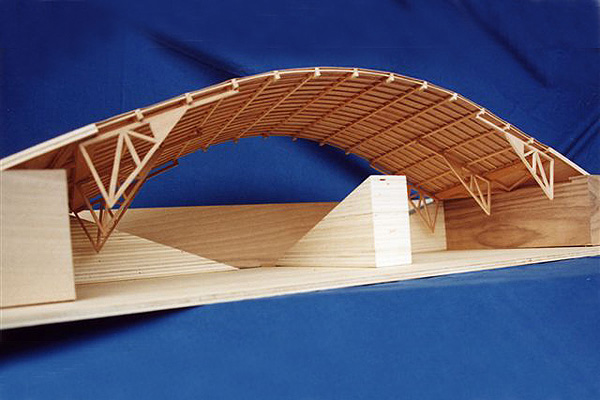
Photo © Matteo Fianchi
Castello Sforzesco, ''Orfeo'', 1983
A scale model (made by the scenographer Matteo Fianchi) of the flexible plane with which Luciano Damiani experimented the ''lower fantastic'' when he was invited, for the Leonardian manifestations of Milan in 1983, to recall the staging by Leonardo da Vinci for the Orfeo by Angelo Poliziano.
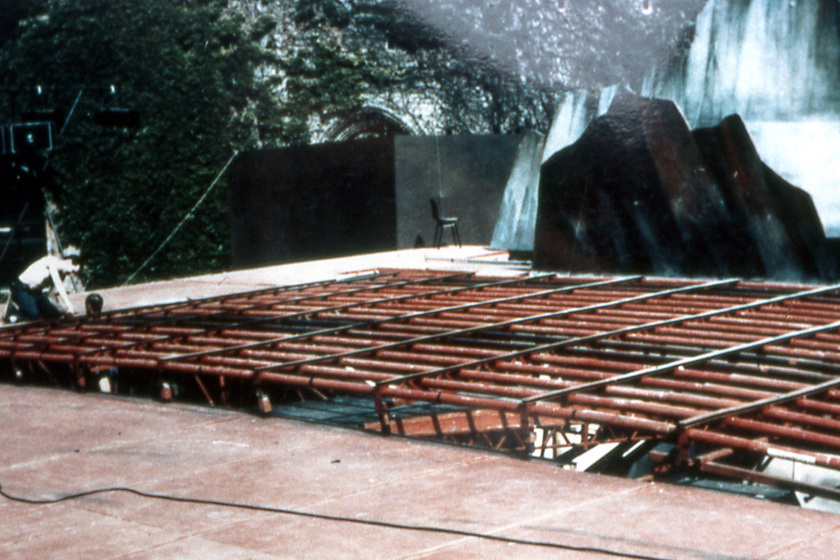
Photo © Daniele Paolin (raccolta personale)
The flexible plane during its installation in the Castello Sforzesco of Milan.
It was 17 m wide, it arched up to a 3.2 m maximum height and it was practicable by the characters and the ballet dancers both in the plain and in the arched positions.
«In that moment I only said that I had to think about it ...»
It was 17 m wide, it arched up to a 3.2 m maximum height and it was practicable by the characters and the ballet dancers both in the plain and in the arched positions.
«In that moment I only said that I had to think about it ...»
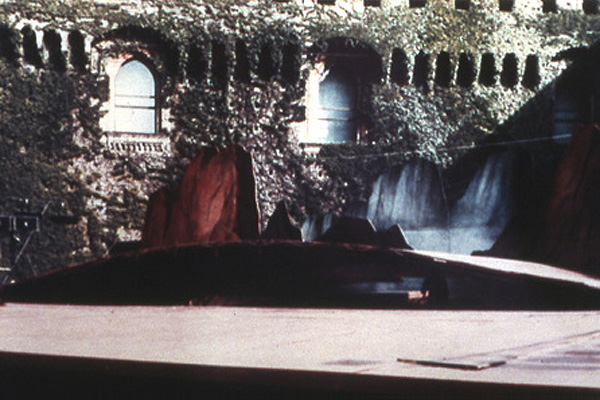
Photo © da Matteo Fianchi, ibidem
«... and that I would perhaps have given a proposal of mine», Luciano Damiani wrote. «I didn't like the idea to remake Leonardo's mise en scène, as it were a model of a science museum.
Discarded the hypothesis of reworking Leonardo's sketches, the way I chose was that to transpose the spirit of his scenography in the modern world.
Leonardo made open a hill as a half dome, making appear the gods below inside it and making get up and go down the characters ...»
Discarded the hypothesis of reworking Leonardo's sketches, the way I chose was that to transpose the spirit of his scenography in the modern world.
Leonardo made open a hill as a half dome, making appear the gods below inside it and making get up and go down the characters ...»
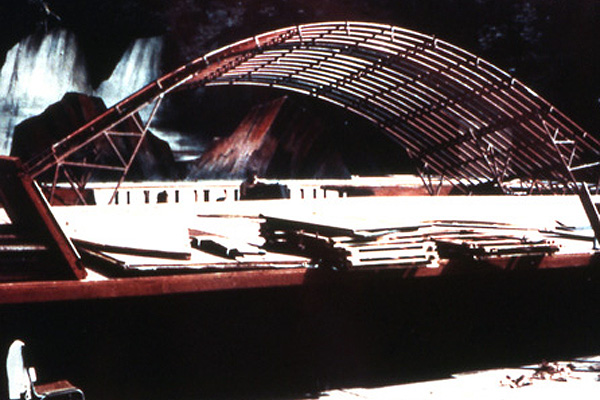
Photo © da Matteo Fianchi, ibidem
«... through a trap door.
I looked for another way, a mechanism that departing from a stage floor became, flexing an arc and returned a stage floor when it was needed, creating an upper space and a lower one.
The same effect that Leonardo had gotten opening the hill and closing it.
It was a lucky occasion because I discovered the element able to complete the theatrical machine that I wanted, the ''lower fantastic''.»
I looked for another way, a mechanism that departing from a stage floor became, flexing an arc and returned a stage floor when it was needed, creating an upper space and a lower one.
The same effect that Leonardo had gotten opening the hill and closing it.
It was a lucky occasion because I discovered the element able to complete the theatrical machine that I wanted, the ''lower fantastic''.»
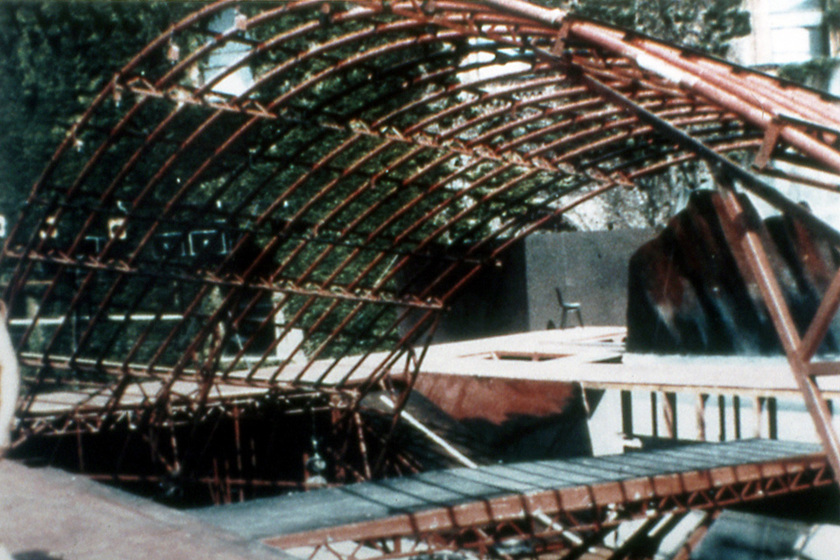
Photo © Daniele Paolin (raccolta personale)
«Arching itself, the plan would have resulted perspective», Daniele Paolin remembers, «for which the front part, nearer to the public, would have been more curved than the back part, suffering unequal pushes and flexing itself in different ways, the structure resulted mostly solicited and this meant to run into further static and dynamic problems.
Yet Damiani, aware of all of this, on purpose chose to realize a perspectival flexible plane.»
Yet Damiani, aware of all of this, on purpose chose to realize a perspectival flexible plane.»
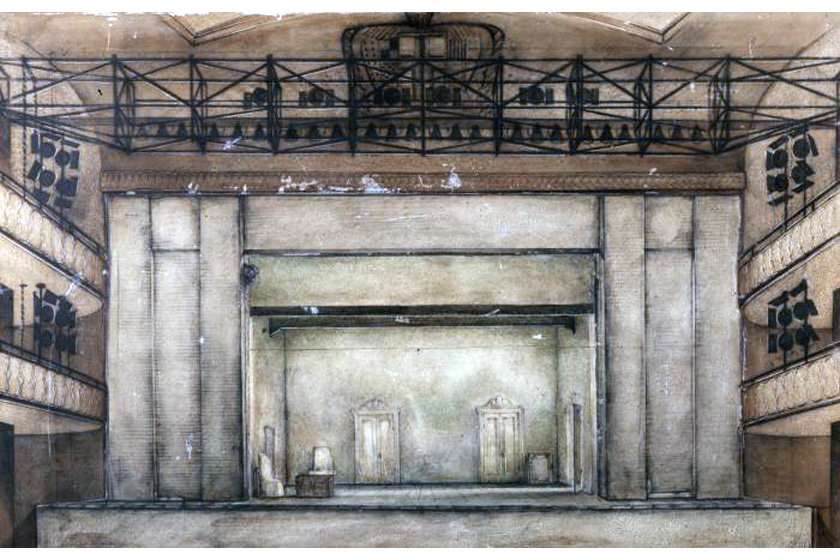
Photo © Luciano Damiani / Piccolo Teatro di Milano
Piccolo Teatro, ''Le baruffe chiozzotte'', 1964
In 1967 Luciano Damiani is involved in a project that, although not realized, will occupy an important place in his artistic maturity, that of Teatro Nuovo of Trieste, that will be stranded for political reasons.
After years of study the works will be interrupted, also opposed ...
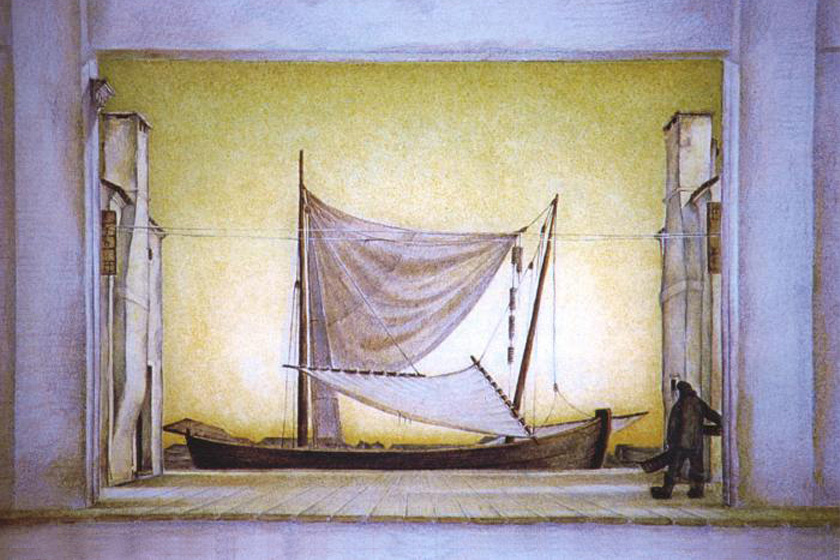
Photo © Luciano Damiani / Piccolo Teatro di Milano
... by an illustrious Triestine: Giorgio Strehler. In Trieste, nevertheless, Damiani develops some ideas that will be used later, in following theatrical scenographies, and a desire of realization that will find form and space, even though in a very different way, at the end of the Seventies, when he will come across some caves, used as stores since the Seventeenth Century, dug in the Monte Testaccio, an artificial hill situated in the port zone of the ancient Rome.
Once restored, the rooms will be occupied ...
Once restored, the rooms will be occupied ...
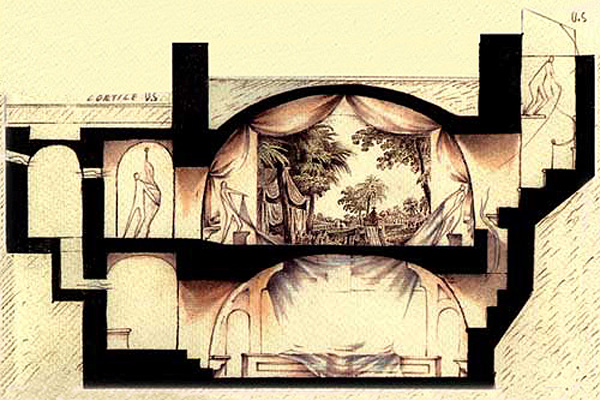
Photo © Teatro di Documenti
... by his Teatro di Documenti, here in a symbolic section, which he will bring to life supported by Luca Ronconi and Giuseppe Sinopoli and on which the great theater critic Franco Quadri will express himself defining it:
«... at once the reality and the picture in which it is painted».
From 1981, almost sixty years old, Damiani personally devotes himself for several years to the restauration of the caves in the Testaccio, the spaces that will compose what he will define ...
«... at once the reality and the picture in which it is painted».
From 1981, almost sixty years old, Damiani personally devotes himself for several years to the restauration of the caves in the Testaccio, the spaces that will compose what he will define ...
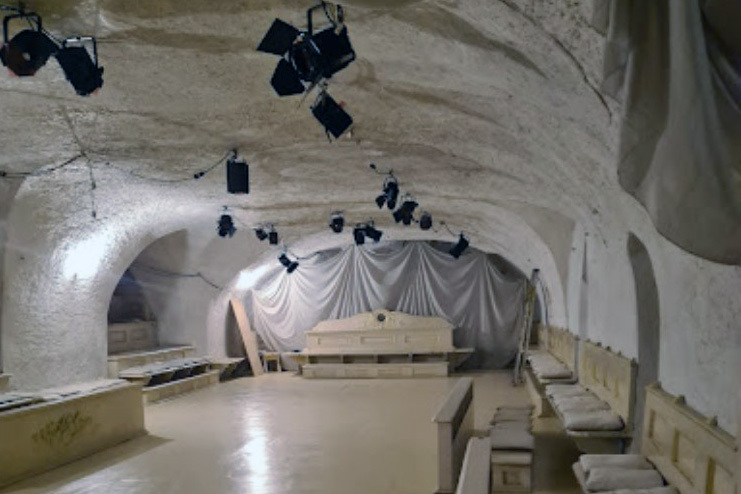
Photo © Peroni
... the ''theatrical cavern'', a temple created to demolish that actor-spectator barrier that his scenographies had already put in discussion.
He will use it up to his death to propose his own theater, finally free from conditionings:
«In this particular moment in which the restlessness dominates the human condition, the assisting to one's own funeral is an utopian desire of many that reassures them.
This is the general rehearsal ...»
He will use it up to his death to propose his own theater, finally free from conditionings:
«In this particular moment in which the restlessness dominates the human condition, the assisting to one's own funeral is an utopian desire of many that reassures them.
This is the general rehearsal ...»
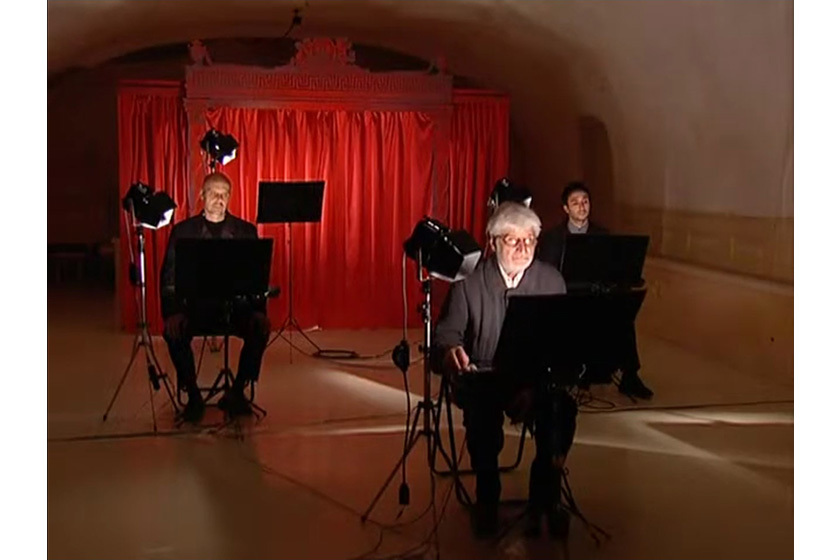
Photo © Teatro di Documenti
«... of mine», Luciano Damiani will play, here in the center during a performance of Self-portrait curtains, a stage adaptation of his autobiographical novel All life and beyond.
«We will repeat it every evening of the show and I will sleep peacefully, satisfied.
Public Bodies and Institutions will spare the expenses for flowers and wreaths, some relatives and acquaintances will spare the hypocritical yearning.»
«We will repeat it every evening of the show and I will sleep peacefully, satisfied.
Public Bodies and Institutions will spare the expenses for flowers and wreaths, some relatives and acquaintances will spare the hypocritical yearning.»
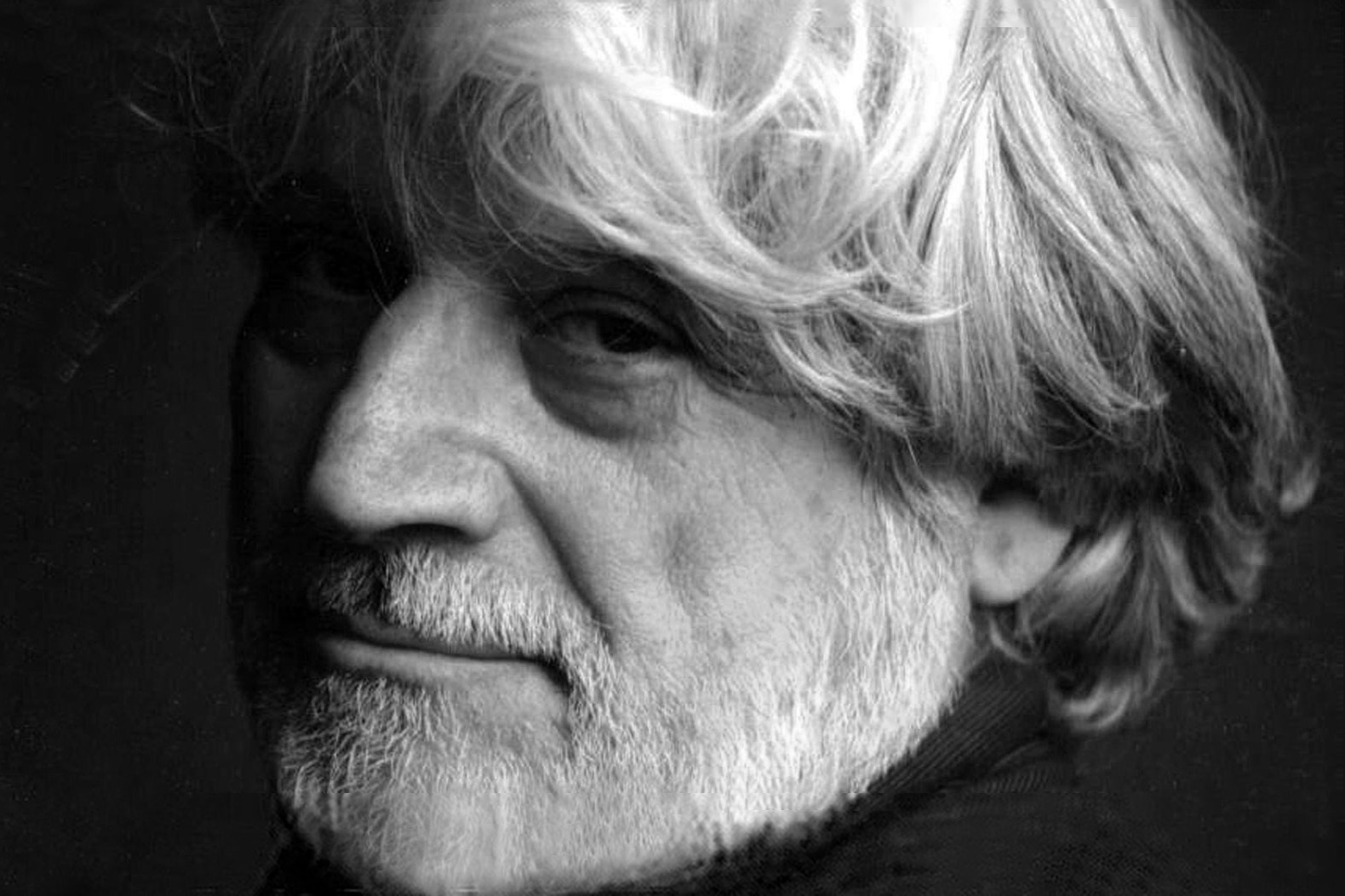
Photo © Piccolo Teatro di Milano
Luciano Damiani died in 2007 in a Roman hospital, after a short stay.
He leaves to posterity a radical evolution of theatrical scenography, of which he has gradually set aside the tradition of flat elements made of painted canvas, replacing them with translucent and dynamically mobile three-dimensional fabric artifacts, used to model spaces and, often, to dilate them from stage to the hall.
He leaves to posterity a radical evolution of theatrical scenography, of which he has gradually set aside the tradition of flat elements made of painted canvas, replacing them with translucent and dynamically mobile three-dimensional fabric artifacts, used to model spaces and, often, to dilate them from stage to the hall.